Trace metals distribution between the surface waters of the Gulf of Cadiz and the Alboran Sea
Identificadores
URI: http://hdl.handle.net/10498/29570
DOI: 10.1016/j.scitotenv.2022.159662
ISSN: 0048-9697
Files
Statistics
Metrics and citations
Export





Metadata
Show full item record
Date
2022-10-24Source
Science of the Total Environment. Vol. 858, Part 2, 1 February 2023, 159662Abstract
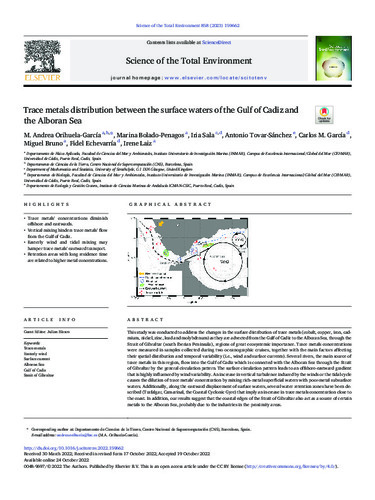
This study was conducted to address the changes in the surface distribution of trace metals (cobalt, copper, iron, cadmium, nickel, zinc, lead and molybdenum) as they are advected from the Gulf of Cadiz to the Alboran Sea, through the Strait of Gibraltar (south Iberian Peninsula), regions of great ecosystemic importance. Trace metals concentrations were measured in samples collected during two oceanographic cruises, together with the main factors affecting their spatial distribution and temporal variability (i.e., wind and surface currents). Several rivers, the main source of trace metals in this region, flow into the Gulf of Cadiz which is connected with the Alboran Sea through the Strait of Gibraltar by the general circulation pattern. The surface circulation pattern leads to an offshore-eastward gradient that is highly influenced by wind variability. An increase in vertical turbulence induced by the winds or the tidal cycle causes the dilution of trace metals' concentration by mixing rich-metal superficial waters with poor-metal subsurface waters. Additionally, along the eastward displacement of surface waters, several water retention zones have been described (Trafalgar, Camarinal, the Coastal Cyclonic Gyre) that imply an increase in trace metals concentration close to the coast. In addition, our results suggest that the coastal edges of the Strait of Gibraltar also act as a source of certain metals to the Alboran Sea, probably due to the industries in the proximity areas
Collections
- Artículos Científicos [11777]
- Articulos Científicos Biología [857]
- Articulos Científicos Fis. Ap. [311]
- Artículos Científicos INMAR [1027]

This work is under a Creative Commons License Atribución 4.0 Internacional