Effects of physical exercise on physical function in older adults in residential care: a systematic review and network meta-analysis of randomised controlled trials
Identificadores
URI: http://hdl.handle.net/10498/29595
DOI: 10.1016/S2666-7568(23)00057-0
ISSN: 2666-7568
Ficheros
Estadísticas
Métricas y Citas
Exportar a





Metadatos
Mostrar el registro completo del ítem
Fecha
2023-05-11Fuente
The Lancet Healthy Longevity. Vol. 4, nº 6, June 2023, pp. e247 - e256Resumen
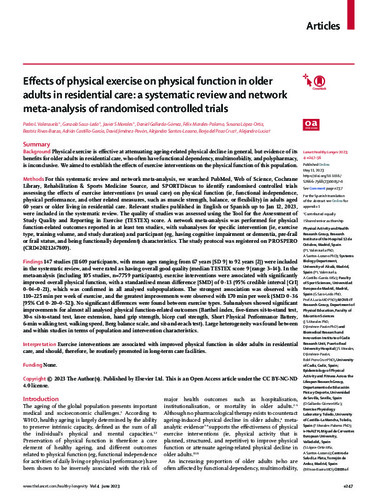
Background: Physical exercise is effective at attenuating ageing-related physical decline in general, but evidence of its benefits for older adults in residential care, who often have functional dependency, multimorbidity, and polypharmacy, is inconclusive. We aimed to establish the effects of exercise interventions on the physical function of this population. Methods: For this systematic review and network meta-analysis, we searched PubMed, Web of Science, Cochrane Library, Rehabilitation & Sports Medicine Source, and SPORTDiscus to identify randomised controlled trials assessing the effects of exercise interventions (vs usual care) on physical function (ie, functional independence, physical performance, and other related measures, such as muscle strength, balance, or flexibility) in adults aged 60 years or older living in residential care. Relevant studies published in English or Spanish up to Jan 12, 2023, were included in the systematic review. The quality of studies was assessed using the Tool for the Assessment of Study Quality and Reporting in Exercise (TESTEX) score. A network meta-analysis was performed for physical function-related outcomes reported in at least ten studies, with subanalyses for specific intervention (ie, exercise type, training volume, and study duration) and participant (eg, having cognitive impairment or dementia, pre-frail or frail status, and being functionally dependent) characteristics. The study protocol was registered on PROSPERO (CRD42021247809). Findings: 147 studies (11 609 participants, with mean ages ranging from 67 years [SD 9] to 92 years [2]) were included in the systematic review, and were rated as having overall good quality (median TESTEX score 9 [range 3–14]). In the meta-analysis (including 105 studies, n=7759 participants), exercise interventions were associated with significantly improved overall physical function, with a standardised mean difference [SMD] of 0·13 (95% credible interval [CrI] 0·04–0·21), which was confirmed in all analysed subpopulations. The strongest association was observed with 110–225 min per week of exercise, and the greatest improvements were observed with 170 min per week (SMD 0·36 [95% CrI 0·20–0·52]). No significant differences were found between exercise types. Subanalyses showed significant improvements for almost all analysed physical function-related outcomes (Barthel index, five-times sit-to-stand test, 30-s sit-to-stand test, knee extension, hand grip strength, bicep curl strength, Short Physical Performance Battery, 6-min walking test, walking speed, Berg balance scale, and sit-and-reach test). Large heterogeneity was found between and within studies in terms of population and intervention characteristics. Interpretation: Exercise interventions are associated with improved physical function in older adults in residential care, and should, therefore, be routinely promoted in long-term care facilities. Funding: None. Translation: For the Spanish translation of the abstract see Supplementary Materials section.
Colecciones
- Artículos Científicos [11595]
- Articulos Científicos Did. E. Fis. [443]

Esta obra está bajo una Licencia Creative Commons Attribution-NonCommercial-NoDerivatives 4.0 Internacional