Accelerometer-measured intensity-specific physical activity, genetic risk and incident type 2 diabetes: A prospective cohort study
Identificadores
URI: http://hdl.handle.net/10498/29721
DOI: 10.1136/bjsports-2022-106653
ISSN: 0306-3674
Files
Statistics
Metrics and citations
Export





Metadata
Show full item record
Date
2023-06-05Source
British Journal of Sports Medicine. Vol. 57, n 19, October 2023, pp. 1257 - 1264Abstract
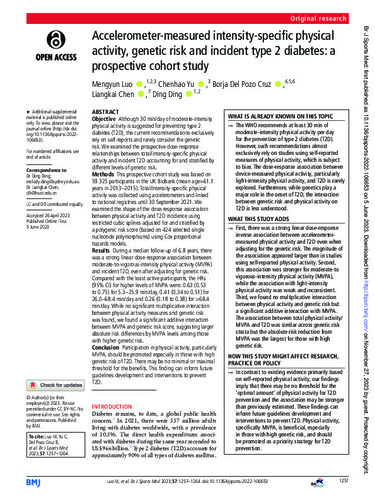
Objective Although 30 min/day of moderate-intensity physical activity is suggested for preventing type 2 diabetes (T2D), the current recommendations exclusively rely on self-reports and rarely consider the genetic risk. We examined the prospective dose-response relationships between total/intensity-specific physical activity and incident T2D accounting for and stratified by different levels of genetic risk. Methods This prospective cohort study was based on 59 325 participants in the UK Biobank (mean age=61.1 years in 2013-2015). Total/intensity-specific physical activity was collected using accelerometers and linked to national registries until 30 September 2021. We examined the shape of the dose-response association between physical activity and T2D incidence using restricted cubic splines adjusted for and stratified by a polygenic risk score (based on 424 selected single nucleotide polymorphisms) using Cox proportional hazards models. Results During a median follow-up of 6.8 years, there was a strong linear dose-response association between moderate-to-vigorous-intensity physical activity (MVPA) and incident T2D, even after adjusting for genetic risk. Compared with the least active participants, the HRs (95% CI) for higher levels of MVPA were: 0.63 (0.53 to 0.75) for 5.3-25.9 min/day, 0.41 (0.34 to 0.51) for 26.0-68.4 min/day and 0.26 (0.18 to 0.38) for >68.4 min/day. While no significant multiplicative interaction between physical activity measures and genetic risk was found, we found a significant additive interaction between MVPA and genetic risk score, suggesting larger absolute risk differences by MVPA levels among those with higher genetic risk. Conclusion Participation in physical activity, particularly MVPA, should be promoted especially in those with high genetic risk of T2D. There may be no minimal or maximal threshold for the benefits. This finding can inform future guidelines development and interventions to prevent T2D.
Collections
- Artículos Científicos [11595]
- Articulos Científicos Did. E. Fis. [443]

This work is under a Creative Commons License Atribución 4.0 Internacional