Reference values for wrist-worn accelerometer physical activity metrics in England children and adolescents
Identificadores
URI: http://hdl.handle.net/10498/29731
DOI: 10.1186/s12966-023-01435-z
ISSN: 1479-5868
Files
Statistics
Metrics and citations
Export





Metadata
Show full item recordAuthor/s
Fairclough, Stuart J.; Rowlands, Alex V.; Pozo Cruz, Borja del ; Crotti, Matteo; Foweather, Lawrence; Graves, Lee E. F.; Hurter, Liezel; Jones, Owen; MacDonald, Mhairi; McCann, Deborah A.; Miller, Caitlin; Noonan, Robert J.; Owen, Michael B.; Rudd, James R.; Taylor, Sarah L.; Tyler, Richard; Boddy, Lynne M.
Date
2023-03-25Source
International Journal of Behavioral Nutrition and Physical Activity. Vol. 20, nº 1, December 2023, 35Abstract
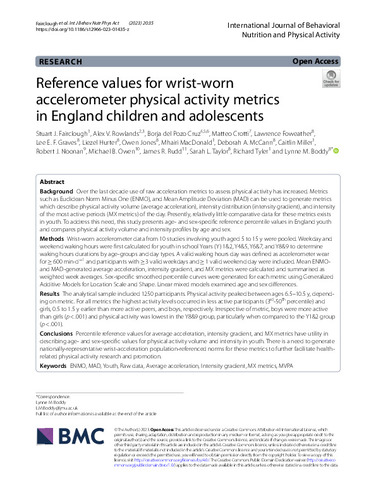
Background: Over the last decade use of raw acceleration metrics to assess physical activity has increased. Metrics such as Euclidean Norm Minus One (ENMO), and Mean Amplitude Deviation (MAD) can be used to generate metrics which describe physical activity volume (average acceleration), intensity distribution (intensity gradient), and intensity of the most active periods (MX metrics) of the day. Presently, relatively little comparative data for these metrics exists in youth. To address this need, this study presents age- and sex-specific reference percentile values in England youth and compares physical activity volume and intensity profiles by age and sex. Methods: Wrist-worn accelerometer data from 10 studies involving youth aged 5 to 15 y were pooled. Weekday and weekend waking hours were first calculated for youth in school Years (Y) 1&2, Y4&5, Y6&7, and Y8&9 to determine waking hours durations by age-groups and day types. A valid waking hours day was defined as accelerometer wear for ≥ 600 min·d−1 and participants with ≥ 3 valid weekdays and ≥ 1 valid weekend day were included. Mean ENMO- and MAD-generated average acceleration, intensity gradient, and MX metrics were calculated and summarised as weighted week averages. Sex-specific smoothed percentile curves were generated for each metric using Generalized Additive Models for Location Scale and Shape. Linear mixed models examined age and sex differences. Results: The analytical sample included 1250 participants. Physical activity peaked between ages 6.5–10.5 y, depending on metric. For all metrics the highest activity levels occurred in less active participants (3rd-50th percentile) and girls, 0.5 to 1.5 y earlier than more active peers, and boys, respectively. Irrespective of metric, boys were more active than girls (p <.001) and physical activity was lowest in the Y8&9 group, particularly when compared to the Y1&2 group (p [removed]
Collections
- Artículos Científicos [11595]
- Articulos Científicos Did. E. Fis. [443]

This work is under a Creative Commons License Atribución 4.0 Internacional