Origin and consequences of brain Toll-like receptor 4 pathway stimulation in an experimental model of depression
Statistics
Metrics and citations
Export





Metadata
Show full item record
Date
2011-11-03Source
Journal of Neuroinflammation, Vol. 8, 2011Abstract
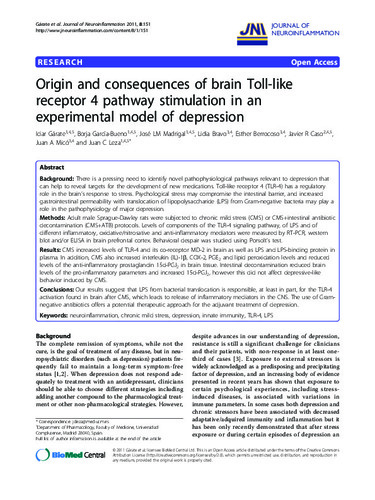
Background: There is a pressing need to identify novel pathophysiological pathways relevant to depression that can help to reveal targets for the development of new medications. Toll-like receptor 4 (TLR-4) has a regulatory role in the brain's response to stress. Psychological stress may compromise the intestinal barrier, and increased gastrointestinal permeability with translocation of lipopolysaccharide (LPS) from Gram-negative bacteria may play a role in the pathophysiology of major depression.
Methods: Adult male Sprague-Dawley rats were subjected to chronic mild stress (CMS) or CMS+intestinal antibiotic decontamination (CMS+ATB) protocols. Levels of components of the TLR-4 signaling pathway, of LPS and of different inflammatory, oxidative/nitrosative and anti-inflammatory mediators were measured by RT-PCR, western blot and/or ELISA in brain prefrontal cortex. Behavioral despair was studied using Porsolt's test.
Results: CMS increased levels of TLR-4 and its co-receptor MD-2 in brain as well as LPS and LPS-binding protein in plasma. In addition, CMS also increased interleukin (IL)-1β, COX-2, PGE2 and lipid peroxidation levels and reduced levels of the anti-inflammatory prostaglandin 15d-PGJ2 in brain tissue. Intestinal decontamination reduced brain levels of the pro-inflammatory parameters and increased 15d-PGJ2, however this did not affect depressive-like behavior induced by CMS.
Conclusions: Our results suggest that LPS from bacterial translocation is responsible, at least in part, for the TLR-4 activation found in brain after CMS, which leads to release of inflammatory mediators in the CNS. The use of Gram-negative antibiotics offers a potential therapeutic approach for the adjuvant treatment of depression.
Collections
- Artículos Científicos [11595]
- Artículos Científicos INIBICA [1046]
- Articulos Científicos Neurociencias [89]

This work is under a Creative Commons License Attribution-NonCommercial-NoDerivatives 4.0 Internacional