Riverine speciation and long dispersal colonization in the Ibero-African Onopordum dissectum complex (Asteraceae)
Identificadores
URI: http://hdl.handle.net/10498/30283
DOI: 10.1093/BOTLINNEAN/BOW022
ISSN: 1095-8339
Statistics
Metrics and citations
Export





Metadata
Show full item record
Date
2017Source
Botanical Journal of the Linnean Society, Vol. 183, Núm. 4, 2017, pp. 600-615Abstract
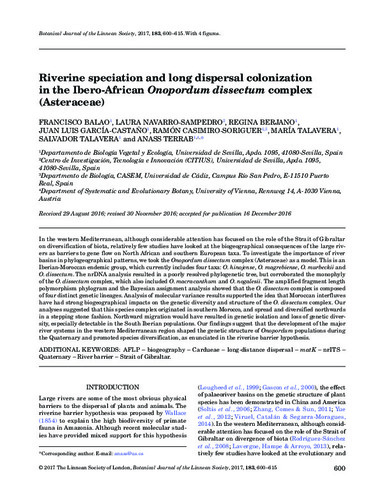
In the western Mediterranean, although considerable attention has focused on the role of the Strait of Gibraltar on diversification of biota, relatively few studies have looked at the biogeographical consequences of the large rivers as barriers to gene flow on North African and southern European taxa. To investigate the importance of river basins in phylogeographical patterns, we took the Onopordum dissectum complex (Asteraceae) as a model. This is an Iberian-Moroccan endemic group, which currently includes four taxa: O. hinojense, O. magrebiense, O. murbeckii and O. dissectum. The nrDNA analysis resulted in a poorly resolved phylogenetic tree, but corroborated the monophyly of the O. dissectum complex, which also included O. macracanthum and O. nogalesii. The amplified fragment length polymorphism phylogram and the Bayesian assignment analysis showed that the O. dissectum complex is composed of four distinct genetic lineages. Analysis of molecular variance results supported the idea that Moroccan interfluves have had strong biogeographical impacts on the genetic diversity and structure of the O. dissectum complex. Our analyses suggested that this species complex originated in southern Morocco, and spread and diversified northwards in a stepping stone fashion. Northward migration would have resulted in genetic isolation and loss of genetic diversity, especially detectable in the South Iberian populations. Our findings suggest that the development of the major river systems in the western Mediterranean region shaped the genetic structure of Onopordum populations during the Quaternary and promoted species diversification, as enunciated in the riverine barrier hypothesis
Collections
- Artículos Científicos [11777]
- Articulos Científicos Biología [857]
- Artículos Científicos IVAGRO [721]