• español
    • English
  • Login
  • español 
    • español
    • English

UniversidaddeCádiz

Área de Biblioteca, Archivo y Publicaciones
Comunidades y colecciones
Ver ítem 
  •   RODIN Principal
  • Producción Científica
  • Artículos Científicos
  • Ver ítem
  •   RODIN Principal
  • Producción Científica
  • Artículos Científicos
  • Ver ítem
JavaScript is disabled for your browser. Some features of this site may not work without it.

An inverse boundary element method computational framework for designing optimal TMS coils
Thumbnail
Identificadores

URI: http://hdl.handle.net/10498/30553

DOI: 10.1016/J.ENGANABOUND.2017.11.002

ISSN: 0955-7997

Ficheros
An inverse boundary element method computational_Optimal_TMS_Coil__PREPRINT.pdf (1.766Mb)
Estadísticas
Ver estadísticas
Métricas y Citas
 
Compartir
Exportar a
Exportar a MendeleyRefworksEndNoteBibTexRIS
Metadatos
Mostrar el registro completo del ítem
Autor/es
Cobos Sánchez, ClementeAutoridad UCA; García Pacheco, Francisco JavierAutoridad UCA; Guerrero Rodríguez, José MaríaAutoridad UCA; Hill, Justin Robert
Fecha
2018-03
Departamento/s
Ingeniería en Automática, Electrónica, Arquitectura y Redes de Computadores; Matemáticas
Fuente
Engineering Analysis with Boundary Elements, Vol. 88, 2018, pp. 156-169
Resumen
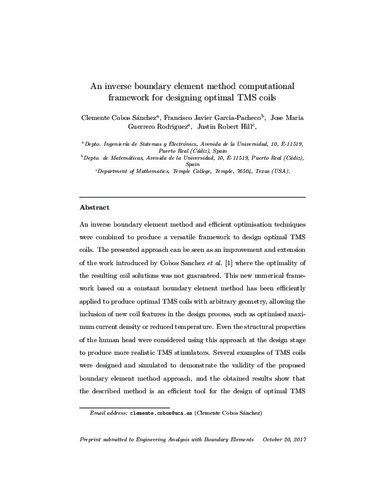
An inverse boundary element method and e cient optimisation techniques were combined to produce a versatile framework to design optimal TMS coils. The presented approach can be seen as an improvement and extension of the work introduced by Cobos Sanchez et al. [1] where the optimality of the resulting coil solutions was not guaranteed. This new numerical framework based on a constant boundary element method has been e ciently applied to produce optimal TMS coils with arbitrary geometry, allowing the inclusion of new coil features in the design process, such as optimised maximum current density or reduced temperature. Even the structural properties of the human head were considered using this approach at the design stage to produce more realistic TMS stimulators. Several examples of TMS coils were designed and simulated to demonstrate the validity of the proposed boundary element method approach, and the obtained results show that the described method is an e cient tool for the design of optimal TMS
Materias
Medical device design; Boundary element method; Convex optimisation; TMS; Field synthesis
Colecciones
  • Artículos Científicos [11595]
  • Articulos Científicos Ing. Sis. Aut. [180]
  • Articulos Científicos Matemáticas [506]
Attribution-NonCommercial-NoDerivatives 4.0 Internacional
Esta obra está bajo una Licencia Creative Commons Attribution-NonCommercial-NoDerivatives 4.0 Internacional

Listar

Todo RODINComunidades y ColeccionesPor fecha de publicaciónAutoresTítulosMateriasEsta colecciónPor fecha de publicaciónAutoresTítulosMaterias

Mi cuenta

AccederRegistro

Estadísticas

Ver Estadísticas de uso

Información adicional

Acerca de...Deposita en RODINPolíticasNormativasDerechos de autorEnlaces de interésEstadísticasNovedadesPreguntas frecuentes

RODIN está accesible a través de

OpenAIREOAIsterRecolectaHispanaEuropeanaBaseDARTOATDGoogle Académico

Enlaces de interés

Sherpa/RomeoDulcineaROAROpenDOARCreative CommonsORCID

RODIN está gestionado por el Área de Biblioteca, Archivo y Publicaciones de la Universidad de Cádiz

ContactoSugerenciasAtención al Usuario

