Solving an IBEM with supporting vector analysis to design quiet TMS coils
Identificadores
URI: http://hdl.handle.net/10498/30554
DOI: 10.1016/J.ENGANABOUND.2020.04.013
ISSN: 0955-7997
Estadísticas
Métricas y Citas
Exportar a





Metadatos
Mostrar el registro completo del ítem
Fecha
2020-08Fuente
Engineering Analysis with Boundary Elements, 2020, Vol. 117, pp. 1-12Resumen
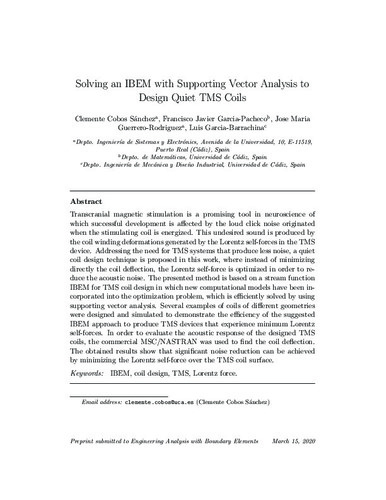
Transcranial magnetic stimulation is a promising tool in neuroscience of which successful development is affected by the loud click noise originated when the stimulating coil is energized. This undesired sound is produced by the coil winding deformations generated by the Lorentz self-forces in the TMS device. Addressing the need for TMS systems that produce less noise, a quiet coil design technique is proposed in this work, where instead of minimizing directly the coil deflection, the Lorentz self-force is optimized in order to reduce the acoustic noise. The presented method is based on a stream function IBEM for TMS coil design in which new computational models have been incorporated into the optimization problem, which is efficiently solved by using supporting vector analysis. Several examples of coils of different geometries were designed and simulated to demonstrate the efficiency of the suggested IBEM approach to produce TMS devices that experience minimum Lorentz self-forces. In order to evaluate the acoustic response of the designed TMS coils, the commercial MSC/NASTRAN was used to find the coil deflection. The obtained results show that significant noise reduction can be achieved by minimizing the Lorentz self-force over the TMS coil surface.
Colecciones

Esta obra está bajo una Licencia Creative Commons Attribution-NonCommercial-NoDerivatives 4.0 Internacional