Associations Between Pedometer-Determined Physical Activity and Adiposity in Children and Adolescents: Systematic Review
Identificadores
URI: http://hdl.handle.net/10498/30643
DOI: 10.1097/JSM.0000000000000419
ISSN: 1050-642X
ISSN: 1536-3724
Ficheros
Estadísticas
Métricas y Citas
Exportar a





Metadatos
Mostrar el registro completo del ítem
Fecha
2018-01Fuente
Clinical Journal of Sport Medicine, Vol. 28, Núm. 1, 2018, pp. 64-75Resumen
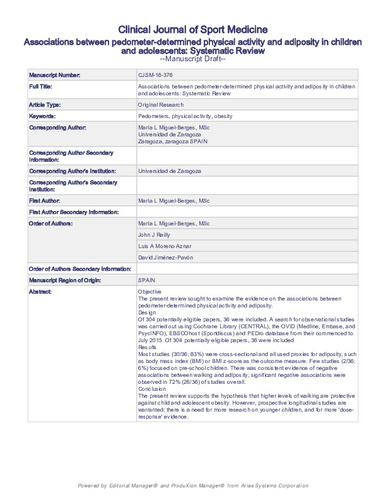
Objective: The present review sought to examine the evidence on the associations between pedometer-determined physical activity and adiposity.
Design: Of 304 potentially eligible articles, 36 were included. A search for observational studies was carried out using Cochrane Library (CENTRAL), the OVID (MEDLINE, Embase, and PsycINFO), EBSCOhost (Sportdiscus), and PEDro database from their commenced to July 2015. Of 304 potentially eligible articles, 36 were included.
Results: Most studies (30/36; 83%) were cross sectional and all used proxies for adiposity, such as body mass index (BMI) or BMI z-score as the outcome measure. Few studies (2/36; 6%) focused on preschool children. There was consistent evidence of negative associations between walking and adiposity; significant negative associations were observed in 72% (26/36) of studies overall.
Conclusions: The present review supports the hypothesis that higher levels of walking are protective against child and adolescent obesity. However, prospective longitudinal studies are warranted; there is a need for more research on younger children and for more "dose-response" evidence.
Colecciones
- Artículos Científicos [11777]
- Articulos Científicos Did. E. Fis. [455]
- Artículos Científicos INIBICA [1083]