• español
    • English
  • Login
  • español 
    • español
    • English

UniversidaddeCádiz

Área de Biblioteca, Archivo y Publicaciones
Comunidades y colecciones
Ver ítem 
  •   RODIN Principal
  • Producción Científica
  • Artículos Científicos
  • Ver ítem
  •   RODIN Principal
  • Producción Científica
  • Artículos Científicos
  • Ver ítem
JavaScript is disabled for your browser. Some features of this site may not work without it.

Exact solutions through symmetry reductions for a high-grade brain tumor model with response to hypoxia.
Thumbnail
Identificadores

URI: http://hdl.handle.net/10498/30937

DOI: https://doi.org/10.1016/j.chaos.2023.113468

Ficheros
1-s2.0-S0960077923003697-main.pdf (1.616Mb)
Estadísticas
Ver estadísticas
Métricas y Citas
 
Compartir
Exportar a
Exportar a MendeleyRefworksEndNoteBibTexRIS
Metadatos
Mostrar el registro completo del ítem
Autor/es
Rosa Durán, MaríaAutoridad UCA; Gandarias Núñez, María LuzAutoridad UCA; Chulian García, SalvadorAutoridad UCA; Niño López, Ana del RosarioAutoridad UCA
Fecha
2023
Departamento/s
Matemáticas
Resumen
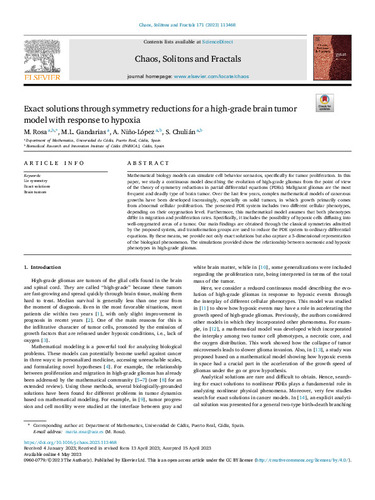
Mathematical biology models can simulate cell behavior scenarios, specifically for tumor proliferation. In this paper, we study a continuous model describing the evolution of high-grade gliomas from the point of view of the theory of symmetry reductions in partial differential equations (PDEs). Malignant gliomas are the most frequent and deadly type of brain tumor. Over the last few years, complex mathematical models of cancerous growths have been developed increasingly, especially on solid tumors, in which growth primarily comes from abnormal cellular proliferation. The presented PDE system includes two different cellular phenotypes, depending on their oxygenation level. Furthermore, this mathematical model assumes that both phenotypes differ in migration and proliferation rates. Specifically, it includes the possibility of hypoxic cells diffusing into well-oxygenated areas of a tumor. Our main findings are obtained through the classical symmetries admitted by the proposed system, and transformation groups are used to reduce the PDE system to ordinary differential equations. By these means, we provide not only exact solutions but also capture a 3-dimensional representation of the biological phenomenon. The simulations provided show the relationship between normoxic and hypoxic phenotypes in high-grade gliomas.
Colecciones
  • Artículos Científicos [11595]
  • Articulos Científicos Matemáticas [506]

Listar

Todo RODINComunidades y ColeccionesPor fecha de publicaciónAutoresTítulosMateriasEsta colecciónPor fecha de publicaciónAutoresTítulosMaterias

Mi cuenta

AccederRegistro

Estadísticas

Ver Estadísticas de uso

Información adicional

Acerca de...Deposita en RODINPolíticasNormativasDerechos de autorEnlaces de interésEstadísticasNovedadesPreguntas frecuentes

RODIN está accesible a través de

OpenAIREOAIsterRecolectaHispanaEuropeanaBaseDARTOATDGoogle Académico

Enlaces de interés

Sherpa/RomeoDulcineaROAROpenDOARCreative CommonsORCID

RODIN está gestionado por el Área de Biblioteca, Archivo y Publicaciones de la Universidad de Cádiz

ContactoSugerenciasAtención al Usuario

