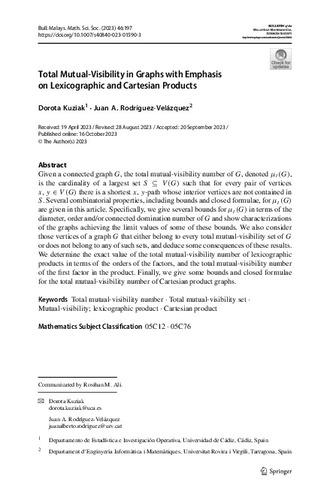
Total Mutual-Visibility in Graphs with Emphasis on Lexicographic and Cartesian Products
Identificadores
URI: http://hdl.handle.net/10498/31379
DOI: 10.1007/s40840-023-01590-3
ISSN: 0126-6705
Ficheros
Estadísticas
Métricas y Citas
Exportar a





Metadatos
Mostrar el registro completo del ítem
Fecha
2023-10-16Fuente
Bulletin of the Malaysian Mathematical Sciences Society. Vol. 46, nº 6, November 2023, 197Resumen
Given a connected graph G, the total mutual-visibility number of G, denoted μt(G) , is the cardinality of a largest set S⊆ V(G) such that for every pair of vertices x, y∈ V(G) there is a shortest x, y-path whose interior vertices are not contained in S. Several combinatorial properties, including bounds and closed formulae, for μt(G) are given in this article. Specifically, we give several bounds for μt(G) in terms of the diameter, order and/or connected domination number of G and show characterizations of the graphs achieving the limit values of some of these bounds. We also consider those vertices of a graph G that either belong to every total mutual-visibility set of G or does not belong to any of such sets, and deduce some consequences of these results. We determine the exact value of the total mutual-visibility number of lexicographic products in terms of the orders of the factors, and the total mutual-visibility number of the first factor in the product. Finally, we give some bounds and closed formulae for the total mutual-visibility number of Cartesian product graphs.
Colecciones
- Artículos Científicos [11595]
- Articulos Científicos Est. I.O. [350]

Esta obra está bajo una Licencia Creative Commons Atribución 4.0 Internacional