Effects of stone-made wind shelter structures over an arid nebkha foredune
Identificadores
URI: http://hdl.handle.net/10498/31425
DOI: 10.1016/j.scitotenv.2023.164934
ISSN: 1879-1026
Ficheros
Estadísticas
Métricas y Citas
Exportar a





Metadatos
Mostrar el registro completo del ítem
Fecha
2023Fuente
Science of the Total Environment - 2023, Vol. 894 pp. 1-15Resumen
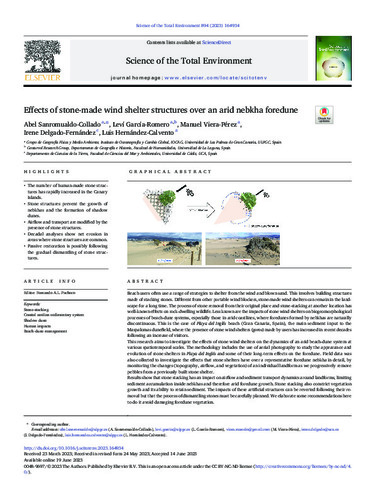
Beach users often use a range of strategies to shelter from the wind and blown sand. This involves building structures
made of stacking stones. Different from other portable wind blockers, stone-made wind shelters can remain in the landscape for a long time. The process of stone removal from their original place and stone-stacking at another location has
well-known effects on rock-dwelling wildlife. Less known are the impacts of stone wind shelters on biogeomorphological
processes of beach-dune systems, especially those in arid coastlines, where foredunes formed by nebkhas are naturally
discontinuous. This is the case of Playa del Inglés beach (Gran Canaria, Spain), the main sediment input to the
Maspalomas dunefield, where the presence of stone wind shelters (goros) made by users has increased in recent decades
following an increase of visitors.
This research aims to investigate the effects of stone wind shelters on the dynamics of an arid beach-dune system at
various spatiotemporal scales. The methodology includes the use of aerial photography to study the appearance and
evolution of stone shelters in Playa del Inglés and some of their long-term effects on the foredune. Field data was
also collected to investigate the effects that stone shelters have over a representative foredune nebkha in detail, by
monitoring the changes (topography, airflow, and vegetation) of an individual landform as we progressively remove
pebbles from a previously built stone shelter.
Results show that stone stacking has an impact on airflow and sediment transport dynamics around landforms, limiting
sediment accumulation inside nebkhas and therefore arid foredune growth. Stone stacking also constrict vegetation
growth and its ability to retain sediment. The impacts of these artificial structures can be reverted following their removal but that the process of dismantling stones must be carefully planned. We elaborate some recommendations here
to do it avoid damaging foredune vegetation
Colecciones
- Artículos Científicos [11595]
- Articulos Científicos CC. Tierra [261]
- Artículos Científicos INMAR [1016]

Esta obra está bajo una Licencia Creative Commons Attribution-NonCommercial-NoDerivatives 4.0 Internacional