Applying active learning by contextualizing robotic applications to historical heritage
Identificadores
URI: http://hdl.handle.net/10498/32279
DOI: https://doi.org/10.1002/CAE.22687
ISSN: 1099-0542
ISSN: 1061-3773
Ficheros
Estadísticas
Métricas y Citas
Exportar a





Metadatos
Mostrar el registro completo del ítem
Fecha
2024Resumen
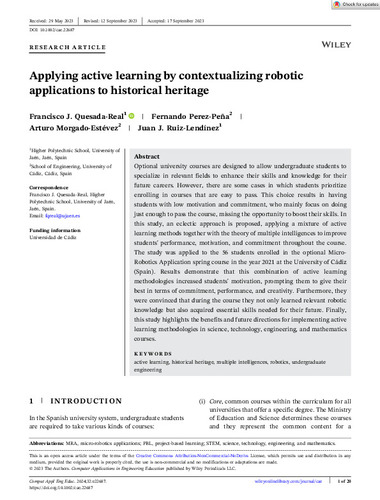
Optional university courses are designed to allow undergraduate students to specialize in relevant fields to enhance their skills and knowledge for their future careers. However, there are some cases in which students prioritize enrolling in courses that are easy to pass. This choice results in having students with low motivation and commitment, who mainly focus on doing just enough to pass the course, missing the opportunity to boost their skills. In this study, an eclectic approach is proposed, applying a mixture of active learning methods together with the theory of multiple intelligences to improve students' performance, motivation, and commitment throughout the course. The study was applied to the 56 students enrolled in the optional Micro-Robotics Application spring course in the year 2021 at the University of Cádiz (Spain). Results demonstrate that this combination of active learning methodologies increased students' motivation, prompting them to give their best in terms of commitment, performance, and creativity. Furthermore, they were convinced that during the course they not only learned relevant robotic knowledge but also acquired essential skills needed for their future. Finally, this study highlights the benefits and future directions for implementing active learning methodologies in science, technology, engineering, and mathematics courses.
Colecciones
- Artículos Científicos [11595]
- Articulos Científicos Ing. Sis. Aut. [180]

Esta obra está bajo una Licencia Creative Commons Atribución-NoComercial-CompartirIgual 4.0 Internacional