Functional mapping to reveal slow conduction and substrate progression in atrial fibrillation
Ficheros
Estadísticas
Métricas y Citas
Exportar a





Metadatos
Mostrar el registro completo del ítem
Fecha
2023Fuente
Europace : European pacing, arrhythmias, and cardiac electrophysiology : journal of the working groups on cardiac pacing, arrhythmias, and cardiac cellular electrophysiology of the European Society of CardiologyResumen
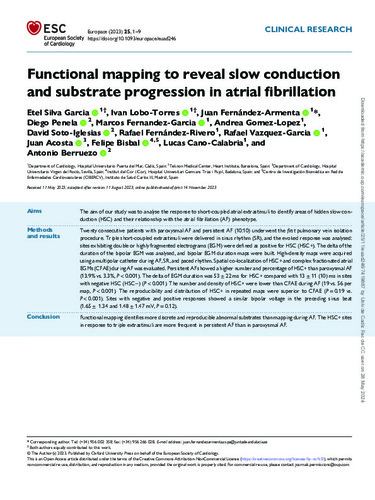
Aims: The aim of our study was to analyse the response to short-coupled atrial extrastimuli to identify areas of hidden slow conduction (HSC) and their relationship with the atrial fibrillation (AF) phenotype. Methods and results: Twenty consecutive patients with paroxysmal AF and persistent AF (10:10) underwent the first pulmonary vein isolation procedure. Triple short-coupled extrastimuli were delivered in sinus rhythm (SR), and the evoked response was analysed: sites exhibiting double or highly fragmented electrograms (EGM) were defined as positive for HSC (HSC+). The delta of the duration of the bipolar EGM was analysed, and bipolar EGM duration maps were built. High-density maps were acquired using a multipolar catheter during AF, SR, and paced rhythm. Spatial co-localization of HSC+ and complex fractionated atrial EGMs (CFAE) during AF was evaluated. Persistent AF showed a higher number and percentage of HSC+ than paroxysmal AF (13.9% vs. 3.3%, P < 0.001). The delta of EGM duration was 53 ± 22ms for HSC+ compared with 13 ± 11 (10)ms in sites with negative HSC (HSC-) (P < 0.001). The number and density of HSC+ were lower than CFAE during AF (19 vs. 56 per map, P < 0.001). The reproducibility and distribution of HSC+ in repeated maps were superior to CFAE (P = 0.19 vs. P < 0.001). Sites with negative and positive responses showed a similar bipolar voltage in the preceding sinus beat (1.65 ± 1.34 and 1.48 ± 1.47mV, P = 0.12). Conclusion: Functional mapping identifies more discrete and reproducible abnormal substrates than mapping during AF. The HSC+ sites in response to triple extrastimuli are more frequent in persistent AF than in paroxysmal AF.
Colecciones
- Artículos Científicos [11595]
- Articulos Científicos Cirugía [72]
- Articulos Científicos Medicina [263]

Esta obra está bajo una Licencia Creative Commons Atribución-NoComercial 4.0 Internacional