Winged resistance: Storks and gulls increase carriage of antibiotic resistance by shifting from paddy fields to landfills
Identificadores
URI: http://hdl.handle.net/10498/32715
DOI: 10.1016/J.SCITOTENV.2024.169946
ISSN: 1879-1026
ISSN: 0048-9697
Ficheros
Estadísticas
Métricas y Citas
Exportar a





Metadatos
Mostrar el registro completo del ítem
Fecha
2024Fuente
Science of the Total Environment, Vol. 914, 2024Resumen
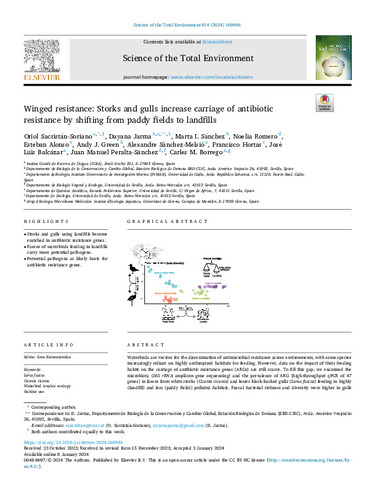
Waterbirds are vectors for the dissemination of antimicrobial resistance across environments, with some species increasingly reliant on highly anthropized habitats for feeding. However, data on the impact of their feeding habits on the carriage of antibiotic resistance genes (ARGs) are still scarce. To fill this gap, we examined the microbiota (16S rRNA amplicon gene sequencing) and the prevalence of ARG (high-throughput qPCR of 47 genes) in faeces from white storks (Ciconia ciconia) and lesser black-backed gulls (Larus fuscus) feeding in highly (landfill) and less (paddy fields) polluted habitats. Faecal bacterial richness and diversity were higher in gulls feeding upon landfills and showed a greater abundance of potential pathogens, such as Staphylococcus. In contrast, faecal bacterial communities from storks were similar regardless of habitat preferences, maybe due to a less intense habitat use compared to gulls. In addition, birds feeding in the landfill carried a higher burden of ARGs compared to the surrounding soil and surface waters. Network analysis revealed strong correlations between ARGs and potential pathogens, particularly between tetM (resistance to tetracyclines), blaCMY (beta-lactam resistance), sul1 (sulfonamide resistance) and members of the genera Streptococcus, Peptostreptococcus, and Peptoclostridium. Our work demonstrates how transitioning from paddy fields to landfills fosters the carriage of ARGs and potential pathogens in the bird gut, shedding light on the ecological role of these avian vectors in antimicrobial resistance dissemination.
Colecciones
- Artículos Científicos [12014]
- Articulos Científicos Biología [865]
- Artículos Científicos INMAR [1043]

Esta obra está bajo una Licencia Creative Commons Atribución-NoComercial 4.0 Internacional