Do the associations of daily steps with mortality and incident cardiovascular disease differ by sedentary time levels? A device-based cohort study
Identificadores
URI: http://hdl.handle.net/10498/32840
DOI: 10.1136/bjsports-2023-107221
ISSN: 1473-0480
ISSN: 0306-3674
Ficheros
Estadísticas
Métricas y Citas
Exportar a





Metadatos
Mostrar el registro completo del ítem
Fecha
2024-01-24Fuente
Ahmadi MN, Rezende LFM, Ferrari G, et al. Br J Sports Med 2024;58:261–268.Resumen
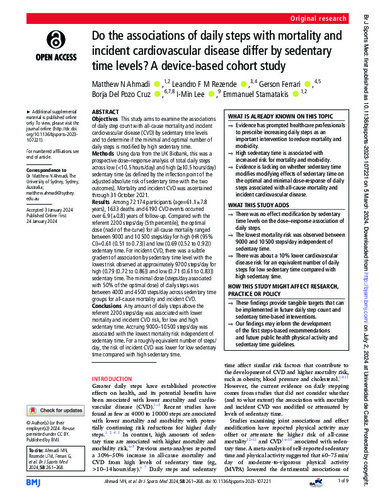
Objectives This study aims to examine the associations of daily step count with all- cause mortality and incident cardiovascular disease (CVD) by sedentary time levels and to determine if the minimal and optimal number of daily steps is modified by high sedentary time. Methods Using data from the UK Biobank, this was a prospective dose–response analysis of total daily steps across low (<10.5 hours/day) and high (≥10.5 hours/day) sedentary time (as defined by the inflection point of the adjusted absolute risk of sedentary time with the two outcomes). Mortality and incident CVD was ascertained through 31 October 2021. Results Among 72 174 participants (age=61.1±7.8 years), 1633 deaths and 6190 CVD events occurred over 6.9 (±0.8) years of follow- up. Compared with the referent 2200 steps/day (5th percentile), the optimal dose (nadir of the curve) for all- cause mortality ranged between 9000 and 10 500 steps/day for high (HR (95% CI)=0.61 (0.51 to 0.73)) and low (0.69 (0.52 to 0.92)) sedentary time. For incident CVD, there was a subtle gradient of association by sedentary time level with the lowest risk observed at approximately 9700 steps/day for high (0.79 (0.72 to 0.86)) and low (0.71 (0.61 to 0.83)) sedentary time. The minimal dose (steps/day associated with 50% of the optimal dose) of daily steps was between 4000 and 4500 steps/day across sedentary time groups for all- cause mortality and incident CVD. Conclusions Any amount of daily steps above the referent 2200 steps/day was associated with lower mortality and incident CVD risk, for low and high sedentary time. Accruing 9000–10 500 steps/day was associated with the lowest mortality risk independent of sedentary time. For a roughly equivalent number of steps/ day, the risk of incident CVD was lower for low sedentary time compared with high sedentary time.
Colecciones
- Artículos Científicos [11595]
- Articulos Científicos Did. E. Fis. [443]

Esta obra está bajo una Licencia Creative Commons Attribution-NonCommercial-NoDerivatives 4.0 Internacional