Effects of Phytase and Microalgae Supplementation on the Utilization of Aquafeeds for European Seabass (Dicentrarchus labrax) Formulated with a High Inclusion Level of Plant Protein
Identificadores
URI: http://hdl.handle.net/10498/33842
DOI: 10.1155/2024/4775004
ISSN: 1365-2109
ISSN: 1355-557X
Ficheros
Estadísticas
Métricas y Citas
Exportar a





Metadatos
Mostrar el registro completo del ítem
Fecha
2024Fuente
Aquaculture Research - 2024, Vol. 2024, artículo n. 4775004Resumen
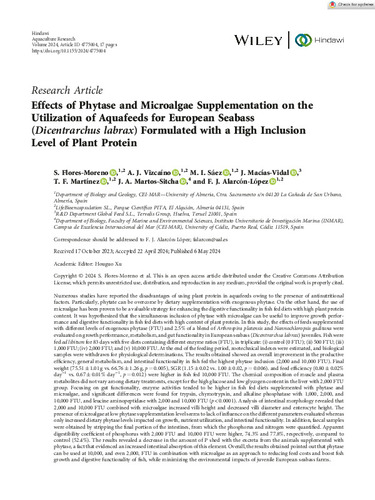
Numerous studies have reported the disadvantages of using plant protein in aquafeeds owing to the presence of antinutritional factors. Particularly, phytate can be overcome by dietary supplementation with exogenous phytase. On the other hand, the use of microalgae has been proven to be a valuable strategy for enhancing the digestive functionality in fish fed diets with high plant protein content. It was hypothesized that the simultaneous inclusion of phytase with microalgae can be useful to improve growth performance and digestive functionality in fish fed diets with high content of plant protein. In this study, the effects of feeds supplemented with different levels of exogenous phytase (FTU) and 2.5% of a blend of Arthrospira platensis and Nannochloropsis gaditana were evaluated on growth performance, metabolism, and gut functionality in European seabass (Dicentrarchus labrax) juveniles. Fish were fed ad libitum for 83 days with five diets containing different enzyme ratios (FTU), in triplicate: (i) control (0 FTU); (ii) 500 FTU; (iii) 1,000 FTU; (iv) 2,000 FTU; and (v) 10,000 FTU. At the end of the feeding period, zootechnical indexes were estimated, and biological samples were withdrawn for physiological determinations. The results obtained showed an overall improvement in the productive efficiency, general metabolism, and intestinal functionality in fish fed the highest phytase inclusion (2,000 and 10,000 FTU). Final weight (75.51 ± 1.01 g vs. 66.76 ± 1.26 g, p=0.005), SGR (1.15 ± 0.02 vs. 1.00 ± 0.02, p=0.006). and feed efficiency (0.80 ± 0.02% day-1 vs. 0.67 ± 0.01% day-1, p=0.012) were higher in fish fed 10,000 FTU. The chemical composition of muscle and plasma metabolites did not vary among dietary treatments, except for the high glucose and low glycogen content in the liver with 2,000 FTU group. Focusing on gut functionality, enzyme activities tended to be higher in fish fed diets supplemented with phytase and microalgae, and significant differences were found for trypsin, chymotrypsin, and alkaline phosphatase with 1,000, 2,000, and 10,000 FTU, and leucine aminopeptidase with 2,000 and 10,000 FTU (p<0.0001). Analysis of intestinal morphology revealed that 2,000 and 10,000 FTU combined with microalgae increased villi height and decreased villi diameter and enterocyte height. The presence of microalgae at low phytase supplementation level seems to lack of influence on the different parameters evaluated whereas only increased dietary phytase levels impacted on growth, nutrient utilization, and intestinal functionality. In addition, faecal samples were obtained by stripping the final portion of the intestines, from which the phosphorus and nitrogen were quantified. Apparent digestibility coefficient of phosphorus with 2,000 FTU and 10,000 FTU were higher, 74.3% and 77.8%, respectively, compared to control (52.4%). The results revealed a decrease in the amount of P shed with the excreta from the animals supplemented with phytase, a fact that evidenced an increased intestinal absorption of this element. Overall, the results obtained pointed out that phytase can be used at 10,000, and even 2,000, FTU in combination with microalgae as an approach to reducing feed costs and boost fish growth and digestive functionality of fish, while minimizing the environmental impacts of juvenile European seabass farms.
Colecciones
- Artículos Científicos [11777]
- Articulos Científicos Biología [857]
- Artículos Científicos INMAR [1027]

Esta obra está bajo una Licencia Creative Commons Atribución 4.0 Internacional