Executive Function Training Through a Mindfulness‑Based Neuroeducational Program in Elementary School Students
Identificadores
URI: http://hdl.handle.net/10498/34190
DOI: 10.1007/S12671-024-02474-8
ISSN: 1868-8535
ISSN: 1868-8527
Estadísticas
Métricas y Citas
Exportar a





Metadatos
Mostrar el registro completo del ítem
Fecha
2024Fuente
Mindfulness, 2024Resumen
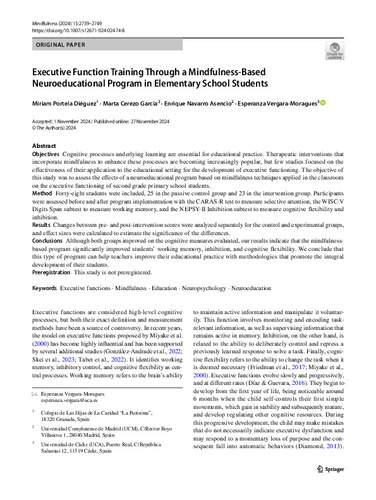
Objectives Cognitive processes underlying learning are essential for educational practice. Therapeutic interventions that incorporate mindfulness to enhance these processes are becoming increasingly popular, but few studies focused on the effectiveness of their application to the educational setting for the development of executive functioning. The objective of this study was to assess the effects of a neuroeducational program based on mindfulness techniques applied in the classroom on the executive functioning of second grade primary school students. Method Forty-eight students were included, 25 in the passive control group and 23 in the intervention group. Participants were assessed before and after program implementation with the CARAS-R test to measure selective attention, the WISC-V Digits Span subtest to measure working memory, and the NEPSY-II Inhibition subtest to measure cognitive flexibility and inhibition. Results Changes between pre- and post-intervention scores were analyzed separately for the control and experimental groups, and effect sizes were calculated to estimate the significance of the differences. Conclusions Although both groups improved on the cognitive measures evaluated, our results indicate that the mindfulnessbased program significantly improved students’ working memory, inhibition, and cognitive flexibility. We conclude that
this type of program can help teachers improve their educational practice with methodologies that promote the integral development of their students.
Colecciones
- Artículos Científicos [11595]
- Articulos Científicos Psicología [419]

Esta obra está bajo una Licencia Creative Commons Attribution-NonCommercial-NoDerivatives 4.0 Internacional