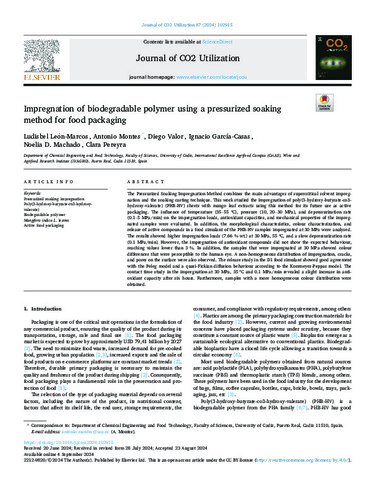
Impregnation of biodegradable polymer using a pressurized soaking method for food packaging
Identificadores
URI: http://hdl.handle.net/10498/35639
DOI: 10.1016/j.jcou.2024.102915
URL: https://www.sciencedirect.com/science/article/pii/S2212982024002506?via%3Dihub
ISSN: 2212-9820
Files
Statistics
Metrics and citations
Export





Metadata
Show full item record
Date
2024Source
Journal of CO2 Utilization Volume 87, September 2024, 102915Abstract
The Pressurized Soaking Impregnation Method combines the main advantages of supercritical solvent impregnation and the soaking casting technique. This work studied the impregnation of poly(3-hydroxy-butyrate-co3-hydroxy-valerate) (PHB-HV) sheets with mango leaf extracts using this method for its future use as active packaging. The influence of temperature (35–55 ºC), pressure (10, 20–30 MPa), and depressurization rate (0.1–5 MPa/min) on the impregnation loads, antioxidant capacities, and mechanical properties of the impregnated samples were evaluated. In addition, the morphological characteristics, colour characterization, and release of active compounds in a food simulant of the PHB-HV samples impregnated at 30 MPa were analysed. The results showed higher impregnation loads (7.66 % wt.) at 30 MPa, 55 ºC, and a slow depressurization rate (0.1 MPa/min). However, the impregnation of antioxidant compounds did not show the expected behaviour, reaching values lower than 3 %. In addition, the samples that were impregnated at 30 MPa showed colour differences that were perceptible to the human eye. A non-homogeneous distribution of impregnation, cracks, and pores on the surface were also observed. The release study in the D1 food simulant showed good agreement with the Peleg model and a quasi-Fickian diffusion behaviour according to the Korsmeyer-Peppas model. The contact time study in the impregnation at 30 MPa, 35 ºC and 0.1 MPa/min revealed a slight increase in antioxidant capacity after six hours. Furthermore, samples with a more homogeneous colour distribution were obtained.
Collections
- Artículos Científicos [11777]
- Artículos Científicos IMEYMAT [565]
- Articulos Científicos Ing. Quim. [308]
- Artículos Científicos IVAGRO [721]