Clarifying terminology and definitions in education services for mental health users: A disambiguation study
Identificadores
URI: http://hdl.handle.net/10498/35704
DOI: 10.1371/JOURNAL.PONE.0306539
ISSN: 1932-6203
Ficheros
Estadísticas
Métricas y Citas
Exportar a





Metadatos
Mostrar el registro completo del ítem
Fecha
2024Fuente
PLoS ONE - 2024, Vol. 19 n. 7 July pp. 1-16Resumen
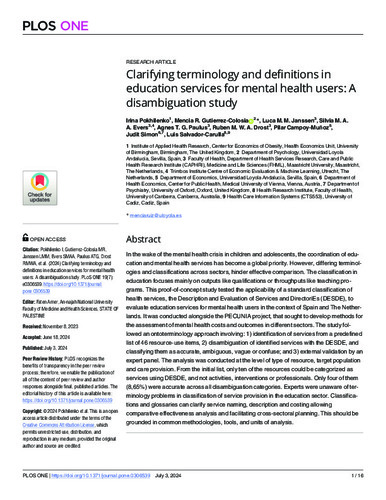
In the wake of the mental health crisis in children and adolescents, the coordination of education and mental health services has become a global priority. However, differing terminologies and classifications across sectors, hinder effective comparison. The classification in education focuses mainly on outputs like qualifications or throughputs like teaching programs. This proof-of-concept study tested the applicability of a standard classification of health services, the Description and Evaluation of Services and DirectoriEs (DESDE), to evaluate education services for mental health users in the context of Spain and The Netherlands. It was conducted alongside the PECUNIA project, that sought to develop methods for the assessment of mental health costs and outcomes in different sectors. The study followed an ontoterminology approach involving: 1) identification of services from a predefined list of 46 resource-use items, 2) disambiguation of identified services with the DESDE, and classifying them as accurate, ambiguous, vague or confuse; and 3) external validation by an expert panel. The analysis was conducted at the level of type of resource, target population and care provision. From the initial list, only ten of the resources could be categorized as services using DESDE, and not activities, interventions or professionals. Only four of them (8,65%) were accurate across all disambiguation categories. Experts were unaware of terminology problems in classification of service provision in the education sector. Classifications and glossaries can clarify service naming, description and costing allowing comparative effectiveness analysis and facilitating cross-sectoral planning. This should be grounded in common methodologies, tools, and units of analysis.
Colecciones
- Artículos Científicos [11595]
- Articulos Científicos Medicina [263]

Esta obra está bajo una Licencia Creative Commons Attribution-NonCommercial-NoDerivatives 4.0 Internacional