Livestock in Phoenician Gadir. Zooarchaeology and taphonomy of the Sagasta-Tinte 1 site (Cádiz, Spain)
Identificadores
Statistics
Export





Metadata
Show full item record
Date
2024Source
30th EAA Annual Meeting (Roma, Italy, 28 - 31 August 2024)Abstract
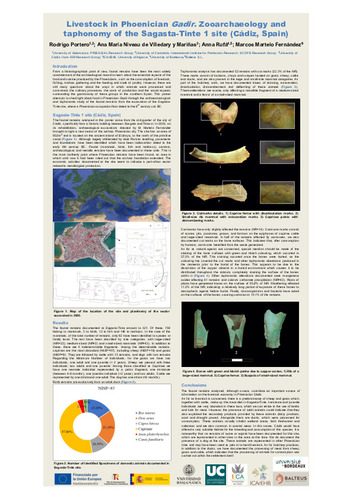
Faunal remains from archaeological sites are a fundamental element for understanding the livestock farming practices of past societies. Through archaeozoological and taphonomic analysis it is possible to determine, among other, food production processes, maintenance activities, the type of meat consumption associated with livestock practices and the cultural aspects of animal processing. In this poster, we present a small assemblage recovered during the emergency archaeological excavation of the site on the corner of street Sagasta and street Tinte in Cádiz. This excavation revealed the existence of structures dedicated to copper mining and metallurgical activity in the Phoenician period, the context of which has been radiocarbon dated to between the end of the 9th and the beginning of the 8th century BC.
Archaeozoological analysis has revealed the importance of sheep, goat, and cattle in the livestock economy of Sagasta-Tinte. Other domestic species such as dogs and ducks have also been found. From a taphonomic point of view, we have documented evidence of anthropic manipulation in mammals and birds, being able to determine different tasks within the animal meat processing chain. Among the anthropic alterations we have documented the use of bone for the manufacture of bone industry. We have also analysed the presence of marks made by carnivores, as well as the natural agents that have affected the transformation of the archaeofaunal record. In this aspect, we should highlight the presence of staining of the bone surfaces with green and bluish colouring due to the dissolution of the copper mineral in a humid environment which causes it to be distributed throughout the stratum, completely staining the surface of the bones, and even covering other previous taphonomic alterations such as cut marks.
Collections

This work is under a Creative Commons License Attribution-NonCommercial-NoDerivatives 4.0 Internacional