Necrolytic migratory erythema associated with glucagonoma treated successfully with cyclosporine
Identificadores
URI: http://hdl.handle.net/10498/36540
DOI: 10.1111/DTH.12498
ISSN: 1529-8019
ISSN: 1396-0296
Statistics
Metrics and citations
Export





Metadata
Show full item record
Date
2017Source
Dermatologic Therapy - 2017, Vol. 30 n. 4 pp. 1-3Abstract
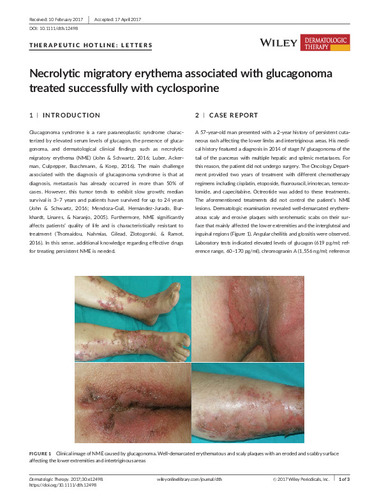
Glucagonoma syndrome is a rare paraneoplastic syndrome characterized by elevated serum levels of glucagon, the presence of glucagonoma, and dermatological clinical findings such as necrolytic
migratory erythema (NME) (John & Schwartz, 2016; Luber, Ackerman, Culpepper, Buschmann, & Koep, 2016). The main challenge
associated with the diagnosis of glucagonoma syndrome is that at
diagnosis, metastasis has already occurred in more than 50% of
cases. However, this tumor tends to exhibit slow growth; median
survival is 3–7 years and patients have survived for up to 24 years
(John & Schwartz, 2016; Mendoza-Guil, Hern andez-Jurado, Burkhardt, Linares, & Naranjo, 2005). Furthermore, NME significantly
affects patients’ quality of life and is characteristically resistant to
treatment (Thomaidou, Nahmias, Gilead, Zlotogorski, & Ramot,
2016). In this sense, additional knowledge regarding effective drugs
for treating persistent NME is needed.
Collections
- Artículos Científicos [11595]
- Articulos Científicos Medicina [263]

This work is under a Creative Commons License Attribution-NonCommercial-NoDerivatives 4.0 Internacional