Cytokine Profiles as Predictive Biomarkers of Disease Severity and Progression in Engineered Stone Silicosis: A Machine Learning Approach
Identificadores
URI: http://hdl.handle.net/10498/37486
DOI: 10.3390/diagnostics15182413
ISSN: 2075-4418
Ficheros
Estadísticas
Métricas y Citas
Exportar a





Metadatos
Mostrar el registro completo del ítem
Fecha
2025Fuente
Diagnostics - 2025, Vol. 15 n.18 2413Resumen
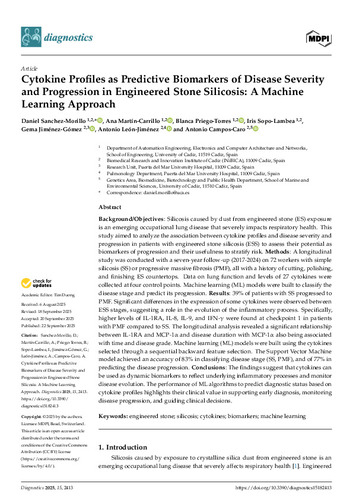
Background/Objectives: Silicosis caused by dust from engineered stone (ES) exposure is an emerging occupational lung disease that severely impacts respiratory health. This study aimed to analyze the association between cytokine profiles and disease severity and progression in patients with engineered stone silicosis (ESS) to assess their potential as biomarkers of progression and their usefulness to stratify risk. Methods: A longitudinal study was conducted with a seven-year follow-up (2017-2024) on 72 workers with simple silicosis (SS) or progressive massive fibrosis (PMF), all with a history of cutting, polishing, and finishing ES countertops. Data on lung function and levels of 27 cytokines were collected at four control points. Machine learning (ML) models were built to classify the disease stage and predict its progression. Results: 39% of patients with SS progressed to PMF. Significant differences in the expression of some cytokines were observed between ESS stages, suggesting a role in the evolution of the inflammatory process. Specifically, higher levels of IL-1RA, IL-8, IL-9, and IFN-γ
were found at checkpoint 1 in patients with PMF compared to SS. The longitudinal analysis revealed a significant relationship between IL-1RA and MCP-1α
and disease duration with MCP-1α
also being associated with time and disease grade. Machine learning (ML) models were built using the cytokines selected through a sequential backward feature selection. The Support Vector Machine model achieved an accuracy of 83% in classifying disease stage (SS, PMF), and of 77% in predicting the disease progression. Conclusions: The findings suggest that cytokines can be used as dynamic biomarkers to reflect underlying inflammatory processes and monitor disease evolution. The performance of ML algorithms to predict diagnostic status based on cytokine profiles highlights their clinical value in supporting early diagnosis, monitoring disease progression, and guiding clinical decisions.
Colecciones
- Artículos Científicos [11595]
- Articulos Científicos Biomedicina [565]
- Articulos Científicos Ing. Sis. Aut. [180]
- Artículos Científicos INIBICA [1046]

Esta obra está bajo una Licencia Creative Commons Atribución 4.0 Internacional