Enhanced Properties of 3D-Printed Graphene Oxide Nanocomposites through Itaconic Acid Polyester Grafting
Ficheros
Estadísticas
Métricas y Citas
Exportar a





Metadatos
Mostrar el registro completo del ítem
Fecha
2025Fuente
ACS Applied Polymer Materials, Vol. 7, Núm. 7, 2025, pp. 4371-4382Resumen
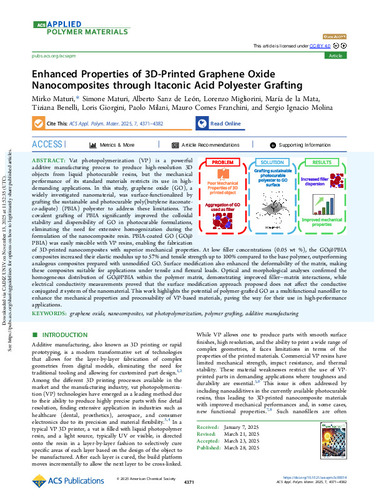
Vat photopolymerization (VP) is a powerful additive manufacturing process to produce high-resolution 3D objects from liquid photocurable resins, but the mechanical performance of its standard materials restricts its use in high-demanding applications. In this study, graphene oxide (GO), a widely investigated nanomaterial, was surface-functionalized by grafting the sustainable and photocurable poly(butylene itaconate-co-adipate) (PBIA) polyester to address these limitations. The covalent grafting of PBIA significantly improved the colloidal stability and dispersibility of GO in photocurable formulations, eliminating the need for extensive homogenization during the formulation of the nanocomposite resin. PBIA-coated GO (GO@PBIA) was easily miscible with VP resins, enabling the fabrication of 3D-printed nanocomposites with superior mechanical properties. At low filler concentrations (0.05 wt %), the GO@PBIA composites increased their elastic modulus up to 57% and tensile strength up to 100% compared to the base polymer, outperforming analogous composites prepared with unmodified GO. Surface modification also enhanced the deformability of the matrix, making these composites suitable for applications under tensile and flexural loads. Optical and morphological analyses confirmed the homogeneous distribution of GO@PBIA within the polymer matrix, demonstrating improved filler-matrix interactions, while electrical conductivity measurements proved that the surface modification approach proposed does not affect the conductive conjugated π system of the nanomaterial. This work highlights the potential of polymer-grafted GO as a multifunctional nanofiller to enhance the mechanical properties and processability of VP-based materials, paving the way for their use in high-performance applications.
Colecciones
- Artículos Científicos [11777]
- Articulos Científicos CC. Mat. [566]
- Artículos Científicos IMEYMAT [565]

Esta obra está bajo una Licencia Creative Commons Atribución 4.0 Internacional