• español
    • English
  • Login
  • English 
    • español
    • English

UniversidaddeCádiz

Área de Biblioteca, Archivo y Publicaciones
Communities and Collections
View Item 
  •   RODIN Home
  • Producción Científica
  • Artículos Científicos
  • View Item
  •   RODIN Home
  • Producción Científica
  • Artículos Científicos
  • View Item
JavaScript is disabled for your browser. Some features of this site may not work without it.

Microwave-Assisted One-Pot Synthesis of Isothiouronium Salts: Experimental and DFT Insights into Silica-Promoted Cyclization toward Thiazolidinium and Thiazole Frameworks
Thumbnail
Identificadores

URI: http://hdl.handle.net/10498/38126

DOI: 10.1021/ACS.JOC.5C01131

ISSN: 1520-6904

ISSN: 0022-3263

Files
OA_2025_0491.pdf (3.892Mb)
Statistics
View statistics
Metrics and citations
 
Share
Export
Export reference to MendeleyRefworksEndNoteBibTexRIS
Metadata
Show full item record
Author/s
Macías Benítez, PabloAuthority UCA; García Algarra, AndrésAuthority UCA; Moreno Dorado, Francisco JavierAuthority UCA; Guerra Martínez, Francisco MiguelAuthority UCA
Date
2025-09-05
Department
Ciencia de los Materiales e Ingeniería Metalúrgica y Química Inorgánica; Química Orgánica
Source
Journal of Organic Chemistry, Vol. 90, Núm. 37, 2025, pp. 12916-12930
Abstract
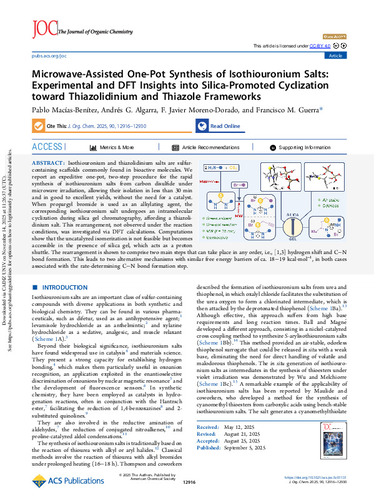
Isothiouronium and thiazolidinium salts are sulfur-containing scaffolds commonly found in bioactive molecules. We report an expeditive one-pot, two-step procedure for the rapid synthesis of isothiouronium salts from carbon disulfide under microwave irradiation, allowing their isolation in less than 30 min and in good to excellent yields, without the need for a catalyst. When propargyl bromide is used as an alkylating agent, the corresponding isothiouronium salt undergoes an intramolecular cyclization during silica gel chromatography, affording a thiazolidinium salt. This rearrangement, not observed under the reaction conditions, was investigated via DFT calculations. Computations show that the uncatalyzed isomerization is not feasible but becomes accessible in the presence of silica gel, which acts as a proton shuttle. The rearrangement is shown to comprise two main steps that can take place in any order, i.e., [1,3] hydrogen shift and C–N bond formation. This leads to two alternative mechanisms with similar free energy barriers of ca. 18–19 kcal·mol–1, in both cases associated with the rate-determining C–N bond formation step.
Subjects
Alkylation; Carbon disulfide; Cyclization; Free energy; Isomerization; Microwave irradiation; Scaffolds; Scaffolds (biology); Sulfur
Collections
  • Artículos Científicos [11777]
Atribución 4.0 Internacional
This work is under a Creative Commons License Atribución 4.0 Internacional

Browse

All of RODINCommunities and CollectionsBy Issue DateAuthorsTitlesSubjectsThis CollectionBy Issue DateAuthorsTitlesSubjects

My Account

LoginRegister

Statistics

View Usage Statistics

Información adicional

AboutDeposit in RODINPoliciesGuidelinesRightsLinksStatisticsNewsFrequently Asked Questions

RODIN is available through

OpenAIREOAIsterRecolectaHispanaEuropeanaBaseDARTOATDGoogle Academic

Related links

Sherpa/RomeoDulcineaROAROpenDOARCreative CommonsORCID

RODIN está gestionado por el Área de Biblioteca, Archivo y Publicaciones de la Universidad de Cádiz

Contact informationSuggestionsUser Support

