Microwave-Assisted One-Pot Synthesis of Isothiouronium Salts: Experimental and DFT Insights into Silica-Promoted Cyclization toward Thiazolidinium and Thiazole Frameworks
Ficheros
Estadísticas
Métricas y Citas
Exportar a





Metadatos
Mostrar el registro completo del ítem
Fecha
2025-09-05Fuente
Journal of Organic Chemistry, Vol. 90, Núm. 37, 2025, pp. 12916-12930Resumen
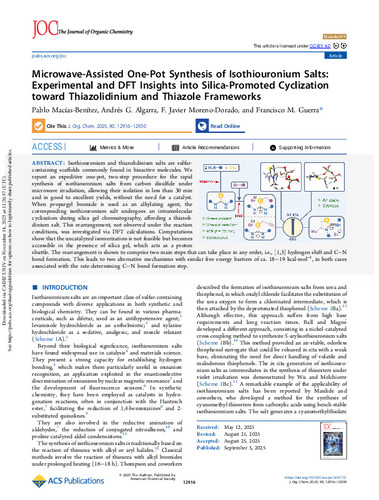
Isothiouronium and thiazolidinium salts are sulfur-containing scaffolds commonly found in bioactive molecules. We report an expeditive one-pot, two-step procedure for the rapid synthesis of isothiouronium salts from carbon disulfide under microwave irradiation, allowing their isolation in less than 30 min and in good to excellent yields, without the need for a catalyst. When propargyl bromide is used as an alkylating agent, the corresponding isothiouronium salt undergoes an intramolecular cyclization during silica gel chromatography, affording a thiazolidinium salt. This rearrangement, not observed under the reaction conditions, was investigated via DFT calculations. Computations show that the uncatalyzed isomerization is not feasible but becomes accessible in the presence of silica gel, which acts as a proton shuttle. The rearrangement is shown to comprise two main steps that can take place in any order, i.e., [1,3] hydrogen shift and C–N bond formation. This leads to two alternative mechanisms with similar free energy barriers of ca. 18–19 kcal·mol–1, in both cases associated with the rate-determining C–N bond formation step.
Colecciones
- Artículos Científicos [12077]

Esta obra está bajo una Licencia Creative Commons Atribución 4.0 Internacional