Is active commuting associated with metabolic syndrome in adults, adolescents, and children? a systematic review and meta-analysis
Identificadores
URI: http://hdl.handle.net/10498/38872
DOI: 10.1016/j.numecd.2025.104227
ISSN: 1590-3729
ISSN: 0939-4753
Ficheros
Estadísticas
Métricas y Citas
Exportar a





Metadatos
Mostrar el registro completo del ítem
Fecha
2025-07-12Fuente
Nutrition, Metabolism and Cardiovascular Diseases, Vol. 35, Núm. 12, 2025Resumen
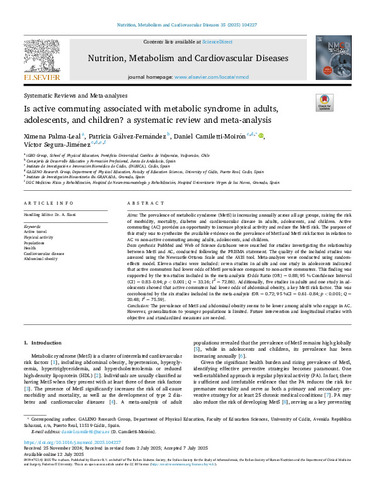
Aims: The prevalence of metabolic syndrome (MetS) is increasing annually across all age groups, raising the risk
of morbidity, mortality, diabetes and cardiovascular disease in adults, adolescents, and children. Active
commuting (AC) provides an opportunity to increase physical activity and reduce the MetS risk. The purpose of
this study was to synthesize the available evidence on the prevalence of MetS and MetS risk factors in relation to
AC vs non-active commuting among adults, adolescents, and children.
Data synthesis: PubMed and Web of Science databases were searched for studies investigating the relationship
between MetS and AC, conducted following the PRISMA statement. The quality of the included studies was
assessed using the Newcastle-Ottawa Scale and the AXIS tool. Meta-analyses were conducted using randomeffects model. Eleven studies were included: seven studies in adults and one study in adolescents indicated
that active commuters had lower odds of MetS prevalence compared to non-active commuters. This finding was
supported by the ten studies included in the meta-analysis (Odds Ratio (OR) = 0.88; 95 % Confidence Interval
(CI) = 0.83–0.94; p < 0.001; Q = 33.16; I
2 = 72.86). Additionally, five studies in adults and one study in adolescents showed that active commuters had lower odds of abdominal obesity, a key MetS risk factor. This was
corroborated by the six studies included in the meta-analysis (OR = 0.72; 95 %CI = 0.61–0.84; p < 0.001; Q =
20.48; I
2 = 75.59).
Conclusion: The prevalence of MetS and abdominal obesity seems to be lower among adults who engage in AC.
However, generalization to younger populations is limited. Future intervention and longitudinal studies with
objective and standardized measures are needed.
Colecciones
- Artículos Científicos [12009]
- Articulos Científicos Did. E. Fis. [461]
- Artículos Científicos INIBICA [1093]

Esta obra está bajo una Licencia Creative Commons Attribution-NonCommercial-NoDerivatives 4.0 Internacional