Leveraging Low-Cost Sensor Data and Predictive Modelling for IoT-Driven Indoor Air Quality Monitoring
Identificadores
URI: http://hdl.handle.net/10498/38912
DOI: 10.3390/smartcities8060200
ISSN: 2624-6511
Ficheros
Estadísticas
Métricas y Citas
Exportar a





Metadatos
Mostrar el registro completo del ítem
Fecha
2025-11-28Fuente
Smart Cities - 2025, vol. 8, nº 6, artículo 200Resumen
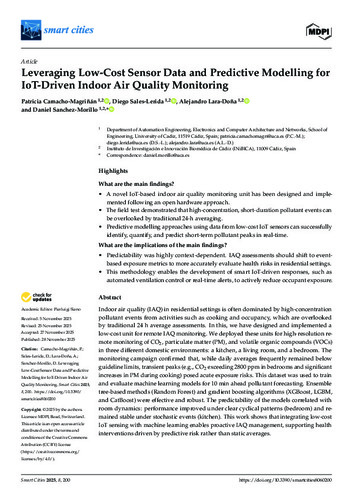
Indoor air quality (IAQ) in residential settings is often dominated by high-concentration pollutant events from activities such as cooking and occupancy, which are overlooked by traditional 24 h average assessments. In this, we have designed and implemented a low-cost unit for remote IAQ monitoring. We deployed these units for high-resolution remote monitoring of CO2, particulate matter (PM), and volatile organic compounds (VOCs) in three different domestic environments: a kitchen, a living room, and a bedroom. The monitoring campaign confirmed that, while daily averages frequently remained below guideline limits, transient peaks (e.g., CO2 exceeding 2800 ppm in bedrooms and significant increases in PM during cooking) posed acute exposure risks. This dataset was used to train and evaluate machine learning models for 10 min ahead pollutant forecasting. Ensemble tree-based methods (Random Forest) and gradient boosting algorithms (XGBoost, LGBM, and CatBoost) were effective and robust. The predictability of the models correlated with room dynamics: performance improved under clear cyclical patterns (bedroom) and remained stable under stochastic events (kitchen). This work shows that integrating low-cost IoT sensing with machine learning enables proactive IAQ management, supporting health interventions driven by predictive risk rather than static averages.
Colecciones
- Artículos Científicos [11777]
- Articulos Científicos Ing. Sis. Aut. [189]