Cytotoxic Triterpene Glycosides from Mexican Sea Cucumber Holothuria inornata
Identificadores
URI: http://hdl.handle.net/10498/39290
DOI: 10.1021/acs.jnatprod.5c00716
ISSN: 0163-3864
Ficheros
Estadísticas
Métricas y Citas
Exportar a





Metadatos
Mostrar el registro completo del ítem
Fecha
2025Fuente
Journal of natural products, Vol. 88, Núm. 10, 2025, pp. 2372-2382Resumen
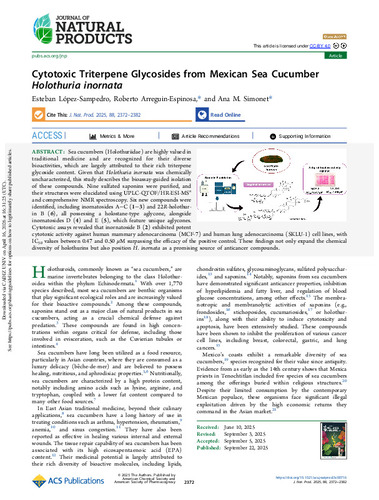
Sea cucumbers (Holothuriidae) are highly valued in traditional medicine and are recognized for their diverse bioactivities, which are largely attributed to their rich triterpene glycoside content. Given that Holothuria inornata was chemically uncharacterized, this study describes the bioassay-guided isolation of these compounds. Nine sulfated saponins were purified, and their structures were elucidated using UPLC-QTOF/HR-ESI-MSn and comprehensive NMR spectroscopy. Six new compounds were identified, including inornatosides A-C (1-3) and 22R-holothurin B (6), all possessing a holostane-type aglycone, alongside inornatosides D (4) and E (5), which feature unique aglycones. Cytotoxic assays revealed that inornatoside B (2) exhibited potent cytotoxic activity against human mammary adenocarcinoma (MCF-7) and human lung adenocarcinoma (SKLU-1) cell lines, with IC50 values between 0.47 and 0.50 μM surpassing the efficacy of the positive control. These findings not only expand the chemical diversity of holothurins but also position H. inornata as a promising source of anticancer compounds.
Colecciones
- Artículos Científicos [11977]
- Articulos Científicos Quim. Org. [327]

Esta obra está bajo una Licencia Creative Commons Atribución 4.0 Internacional