Children and young people with persistent post-COVID-19 condition over 24 months: a mixed-methods study
Identificadores
URI: http://hdl.handle.net/10498/39319
DOI: 10.1136/BMJPO-2025-003634
ISSN: 2399-9772
Ficheros
Estadísticas
Métricas y Citas
Exportar a





Metadatos
Mostrar el registro completo del ítem
Fecha
2025Fuente
BMJ Paediatrics Open-2025 Vol. 9 n.1, e003634Resumen
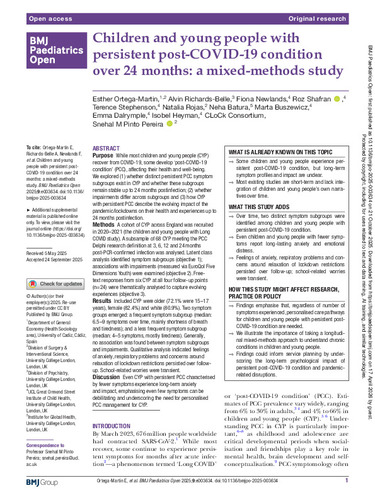
Purpose While most children and young people (CYP) recover from COVID-19, some develop ‘post-COVID-19 condition’ (PCC), affecting their health and well-being. We explored (1) whether distinct persistent PCC symptom subgroups exist in CYP and whether these subgroups remain stable up to 24 months postinfection; (2) whether impairments differ across subgroups and (3) how CYP with persistent PCC describe the evolving impact of the pandemic/lockdowns on their health and experiences up to 24 months postinfection. Methods A cohort of CYP across England was recruited in 2020–2021 (the children and young people with Long COVID study). A subsample of 68 CYP meeting the PCC Delphi research definition at 3, 6, 12 and 24 months post-PCR-confirmed infection was analysed. Latent class analysis identified symptom subgroups (objective 1); associations with impairments (measured via EuroQol Five Dimensions Youth) were examined (objective 2). Free-text responses from six CYP at all four follow-up points (n=24) were thematically analysed to capture evolving experiences (objective 3). Results Included CYP were older (72.1% were 15–17 years), female (82.4%) and white (80.9%). Two symptom groups emerged: a frequent symptom subgroup (median: 6.5–9 symptoms over time, mainly shortness of breath and tiredness); and a less frequent symptom subgroup (median: 4–5 symptoms, mostly tiredness). Generally, no association was found between symptom subgroups and impairments. Qualitative analysis indicated feelings of anxiety, respiratory problems and concerns around relaxation of lockdown restrictions persisted over followup. School-related worries were transient. Discussion Even CYP with persistent PCC characterised by fewer symptoms experience long-term anxiety and impact, emphasising even few symptoms can be debilitating and underscoring the need for personalised PCC management for CYP.
Colecciones
- Artículos Científicos [11777]
- Articulos Científicos Ec. Gen. [269]

Esta obra está bajo una Licencia Creative Commons Atribución 4.0 Internacional