Chlorophyll-α forecasting using LSTM, bidirectional LSTM and GRU networks in El Mar Menor (Spain)
Ficheros
Estadísticas
Métricas y Citas
Exportar a





Metadatos
Mostrar el registro completo del ítem
Fecha
2024Fuente
Logic Journal of the IGPL - 2024, Vol. jzae046Resumen
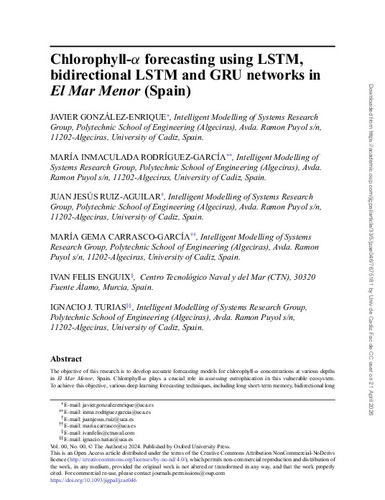
The objective of this research is to develop accurate forecasting models for chlorophyll-α concentrations at various depths in El Mar Menor, Spain. Chlorophyll-α plays a crucial role in assessing eutrophication in this vulnerable ecosystem. To achieve this objective, various deep learning forecasting techniques, including long short-term memory, bidirectional long short-term memory and gated recurrent uni networks, were utilized. The models were designed to forecast the chlorophyll-α levels with a 2-week prediction horizon. To enhance the models’ accuracy, a sliding window method combined with a blocked cross-validation procedure for time series was also applied to these techniques. Two input strategies were also tested in this approach: using only chlorophyll-α time series and incorporating exogenous variables. The proposed approach significantly improved the accuracy of the predictive models, no matter the forecasting technique employed. Results were remarkable, with values reaching approximately 0.90 for the 0.5-m depth level and 0.80 for deeper levels. The proposed forecasting models and methodologies have great potential for predicting eutrophication episodes and acting as decision-making tools for environmental agencies. Accurate prediction of eutrophication episodes through these models could allow for proactive measures to be implemented, resulting in improved environmental management and the preservation of the ecosystem.
Colecciones
- Artículos Científicos [11973]
- Articulos Científicos Ing. Ind. [96]
- Articulos Científicos Ing. Inf. [313]

Esta obra está bajo una Licencia Creative Commons Attribution-NonCommercial-NoDerivatives 4.0 Internacional