Fine-Tuning Catalysts: The Role of Support Nanomorphology in Shaping Cu/CeO2CO-PROX Properties
Ficheros
Estadísticas
Métricas y Citas
Exportar a





Metadatos
Mostrar el registro completo del ítem
Fecha
2025-11Fuente
ACS Catalysis, Vol. 15, 2025, pp. 20360-20376Resumen
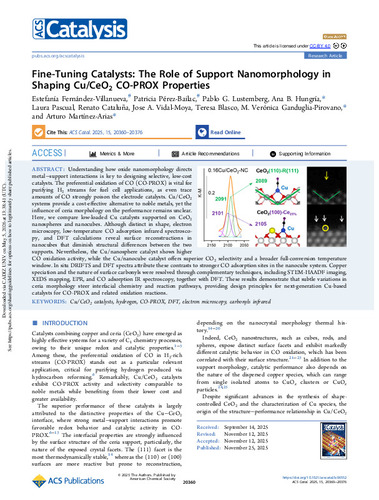
Understanding how oxide nanomorphology directs metal–support interactions is key to designing selective, low-cost catalysts. The preferential oxidation of CO (CO-PROX) is vital for purifying H2streams for fuel cell applications, as even trace amounts of CO strongly poison the electrode catalysts. Cu/CeO2systems provide a cost-effective alternative to noble metals, yet the influence of ceria morphology on the performance remains unclear. Here, we compare low-loaded Cu catalysts supported on CeO2nanospheres and nanocubes. Although distinct in shape, electron microscopy, low-temperature CO adsorption infrared spectroscopy, and DFT calculations reveal surface reconstructions in nanocubes that diminish structural differences between the two supports. Nevertheless, the Cu/nanosphere catalyst shows higher CO oxidation activity, while the Cu/nanocube catalyst offers superior CO2selectivity and a broader full-conversion temperature window. In situ DRIFTS and DFT spectra attribute these contrasts to stronger CO adsorption sites in the nanocube system. Copper speciation and the nature of surface carbonyls were resolved through complementary techniques, including STEM-HAADF imaging, XEDS mapping, EPR, and CO adsorption IR spectroscopy, together with DFT. These results demonstrate that subtle variations in ceria morphology steer interfacial chemistry and reaction pathways, providing design principles for next-generation Cu-based catalysts for CO-PROX and related oxidation reactions.
Colecciones
- Artículos Científicos [12077]
- Articulos Científicos CC. Mat. [585]
- Articulos Científicos Fis. Ap. [318]

Esta obra está bajo una Licencia Creative Commons Atribución 4.0 Internacional