Benthic assemblage responses to different sources of macrophyte detritus using contrasting methodological approaches
Identificadores
URI: http://hdl.handle.net/10498/39549
DOI: 10.1007/S00227-025-04743-Z
ISSN: 1432-1793
ISSN: 0025-3162
Ficheros
Estadísticas
Métricas y Citas
Exportar a





Metadatos
Mostrar el registro completo del ítem
Fecha
2025-11-20Fuente
Marine Biology 2026, Vol. 173, Núm. 1, 2Resumen
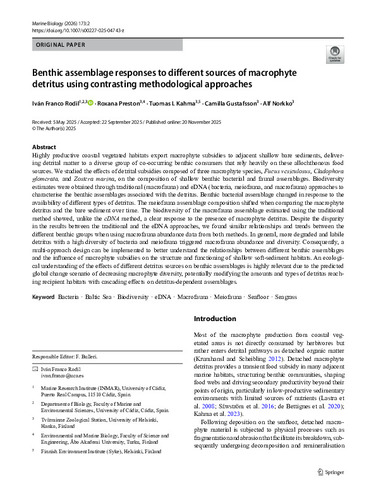
Highly productive coastal vegetated habitats export macrophyte subsidies to adjacent shallow bare sediments, delivering detrital matter to a diverse group of co-occurring benthic consumers that rely heavily on these allochthonous food sources. We studied the effects of detrital subsidies composed of three macrophyte species, Fucus vesiculosus, Cladophora glomerata, and Zostera marina, on the composition of shallow benthic bacterial and faunal assemblages. Biodiversity estimates were obtained through traditional (macrofauna) and eDNA (bacteria, meiofauna, and macrofauna) approaches to characterise the benthic assemblages associated with the detritus. Benthic bacterial assemblage changed in response to the availability of different types of detritus. The meiofauna assemblage composition shifted when comparing the macrophyte detritus and the bare sediment over time. The biodiversity of the macrofauna assemblage estimated using the traditional method showed, unlike the eDNA method, a clear response to the presence of macrophyte detritus. Despite the disparity in the results between the traditional and the eDNA approaches, we found similar relationships and trends between the different benthic groups when using macrofauna abundance data from both methods. In general, more degraded and labile detritus with a high diversity of bacteria and meiofauna triggered macrofauna abundance and diversity. Consequently, a multi-approach design can be implemented to better understand the relationships between different benthic assemblages and the influence of macrophyte subsidies on the structure and functioning of shallow soft-sediment habitats. An ecological understanding of the effects of different detritus sources on benthic assemblages is highly relevant due to the predicted global change scenario of decreasing macrophyte diversity, potentially modifying the amounts and types of detritus reaching recipient habitats with cascading effects on detritus-dependent assemblages
Colecciones
- Artículos Científicos [11777]
- Articulos Científicos Biología [857]

Esta obra está bajo una Licencia Creative Commons Atribución 4.0 Internacional