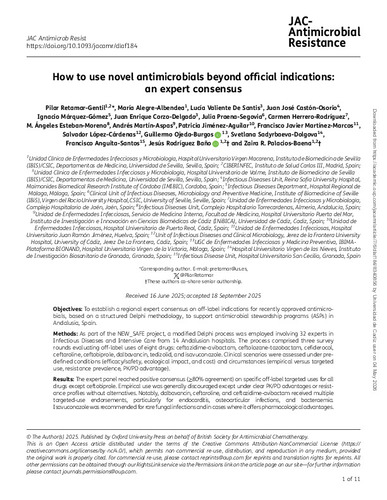
How to use novel antimicrobials beyond official indications: an expert consensus
Statistics
Metrics and citations
Export





Metadata
Show full item recordAuthor/s
Retamar Gentil, Pilar; Alegre Albendea, María; Valiente de Santis, Lucia; Castón-Osorio, Juan José; Márquez-Gómez, Ignacio; Corzo-Delgado, Juan Enrique; Praena Segovia, Julia; Herrero Rodríguez, Carmen; Esteban Moreno, M. Ángeles; Martín Aspas, Andrés ; Jiménez Aguilar, Patricia; Martínez-Marcos, Francisco Javier; López Cardenas, Salvador; Ojeda Burgos, Guillermo; Sadyrbaeva Dolgova, Svetlana; Anguita Santos, Francisco; Rodríguez Baño, Jesús; Palacio Baena, Zaira
Date
2025-11-24Source
JAC-antimicrobial resistance - 2025, Vol. 7, Núm. 6,Abstract
Objectives
To establish a regional expert consensus on off-label indications for recently approved antimicrobials, based on a structured Delphi methodology, to support antimicrobial stewardship programs (ASPs) in Andalusia, Spain.
Methods
As part of the NEW_SAFE project, a modified Delphi process was employed involving 32 experts in Infectious Diseases and Intensive Care from 14 Andalusian hospitals. The process comprised three survey rounds evaluating off-label uses of eight drugs: ceftazidime-avibactam, ceftolozane-tazobactam, cefiderocol, ceftaroline, ceftobiprole, dalbavancin, tedizolid, and isavuconazole. Clinical scenarios were assessed under predefined conditions (efficacy/safety, ecological impact, and cost) and circumstances (empirical versus targeted use, resistance prevalence, PK/PD advantage).
Results
The expert panel reached positive consensus (≥80% agreement) on specific off-label targeted uses for all drugs except ceftobiprole. Empirical use was generally discouraged except under clear PK/PD advantages or resistance profiles without alternatives. Notably, dalbavancin, ceftaroline, and ceftazidime-avibactam received multiple targeted-use endorsements, particularly for endocarditis, osteoarticular infections, and bacteraemia. Isavuconazole was recommended for rare fungal infections and in cases where it offers pharmacological advantages.
Conclusions
This consensus supports the judicious off-label use of new antimicrobials in specific clinical scenarios where therapeutic gaps exist. The guidance prioritizes targeted treatment over empirical use, aligning with international ASP principles and WHO recommendations. These results provide a regional reference to optimize ASP initiatives focus on new antibiotic use while minimizing ecological impact and resistance development.
Collections
- Artículos Científicos [11595]

This work is under a Creative Commons License Atribución-NoComercial 4.0 Internacional