Bioenergy potential of agricultural straw residues from Southern Spain
Identificadores
URI: http://hdl.handle.net/10498/40074
DOI: 10.1038/s41598-026-46840-z
ISSN: 2045-2322
Ficheros
Estadísticas
Métricas y Citas
Exportar a





Metadatos
Mostrar el registro completo del ítem
Fecha
2026Fuente
Scientific Reports - 2026, Vol. 16 n.1Resumen
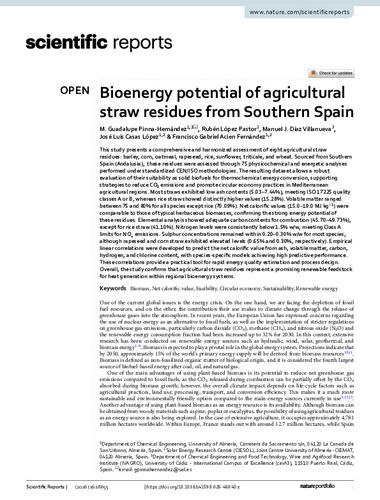
This study presents a comprehensive and harmonized assessment of eight agricultural straw residues: barley, corn, oatmeal, rapeseed, rice, sunflower, triticale, and wheat. Sourced from Southern Spain (Andalusia), these residues were assessed through 75 physicochemical and energetic analyses performed under standardized CEN/ISO methodologies. The resulting dataset allows a robust evaluation of their suitability as solid biofuels for thermochemical energy conversion, supporting strategies to reduce CO₂ emissions and promote circular economy practices in Mediterranean agricultural regions. Most straws exhibited low ash contents (5.03–7.44%), meeting ISO 17225 quality classes A or B, whereas rice straw showed distinctly higher values (15.28%). Volatile matter ranged between 75 and 80% for all species except rice (70.09%). Net calorific values (15.0–19.0 MJ kg−1) were comparable to those of typical herbaceous biomasses, confirming the strong energy potential of these residues. Elemental analysis showed adequate carbon contents for combustion (45.70–49.73%), except for rice straw (41.10%). Nitrogen levels were consistently below 1.5% w/w, meeting Class A limits for NOx emissions. Sulphur concentrations remained within 0.20–0.30% w/w for most species, although rapeseed and corn straw exhibited elevated levels (0.65% and 0.30%, respectively). Empirical linear correlations were developed to predict the net calorific value from ash, volatile matter, carbon, hydrogen, and chlorine content, with species-specific models achieving high predictive performance. These correlations provide a practical tool for rapid energy quality estimation and process design. Overall, the study confirms that agricultural straw residues represent a promising renewable feedstock for heat generation within regional bioenergy systems.
Colecciones
- Artículos Científicos [11954]
- Articulos Científicos Ing. Quim. [312]
- Artículos Científicos IVAGRO [730]

Esta obra está bajo una Licencia Creative Commons Attribution-NonCommercial-NoDerivatives 4.0 Internacional