Reliability and structural validity of the Female Sexual Function Index in Spanish female university students
Identificadores
URI: http://hdl.handle.net/10498/40099
DOI: 10.3389/fpsyg.2026.1877071
ISSN: 1664-1078
Ficheros
Estadísticas
Métricas y Citas
Exportar a





Metadatos
Mostrar el registro completo del ítem
Fecha
2026-07-24Fuente
Frontiers in Psychology, Volume 17 - 2026Resumen
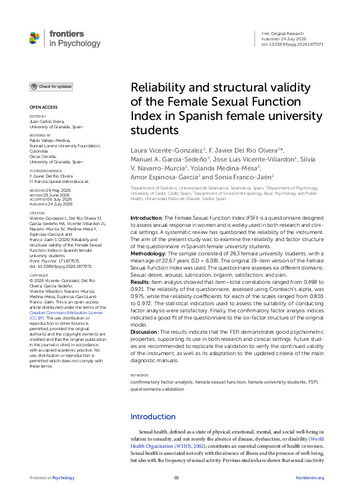
Introduction: The Female Sexual Function Index (FSFI) is a questionnaire designed
to assess sexual response in women and is widely used in both research and clinical
settings. A systematic review has questioned the reliability of the instrument.
The aim of the present study was to examine the reliability and factor structure
of the questionnaire in Spanish female university students.
Methodology: The sample consisted of 263 female university students, with a
mean age of 22.67 years (SD = 6.08). The original 19-item version of the Female
Sexual Function Index was used. The questionnaire assesses six different domains:
Sexual desire, arousal, lubrication, orgasm, satisfaction, and pain.
Results: Item analysis showed that item–total correlations ranged from 0.498 to
0.921. The reliability of the questionnaire, assessed using Cronbach’s alpha, was
0.975, while the reliability coefficients for each of the scales ranged from 0.803
to 0.972. The statistical indicators used to assess the suitability of conducting
factor analysis were satisfactory. Finally, the confirmatory factor analysis indices
indicated a good fit of the questionnaire to the six-factor structure of the original
model.
Discussion: The results indicate that the FSFI demonstrates good psychometric
properties, supporting its use in both research and clinical settings. Future studies
are recommended to replicate the validation to verify the continued validity
of the instrument, as well as its adaptation to the updated criteria of the main
diagnostic manuals.
Colecciones
- Artículos Científicos [11777]

Esta obra está bajo una Licencia Creative Commons Attribution 4.0 Internacional