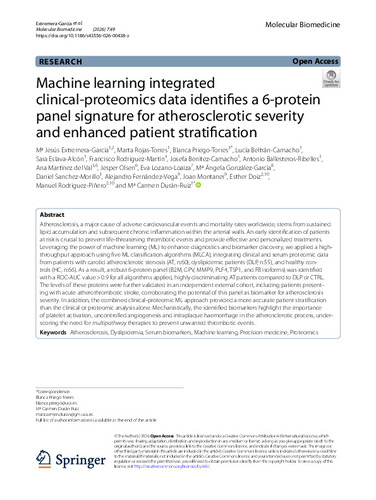
Machine learning integrated clinical‑proteomics data identifies a 6‑protein panel signature for atherosclerotic severity and enhanced patient stratification
Identificadores
URI: http://hdl.handle.net/10498/40797
DOI: 10.1186/S43556-026-00438-Z
ISSN: 2662-8651
Ficheros
Estadísticas
Métricas y Citas
Exportar a





Metadatos
Mostrar el registro completo del ítemAutor/es
Extremera García, Mª Jesús; Rojas Torres, Marta ; Priego Torres, Blanca María; Beltrán Camacho, Lucía; Eslava Alcón, Sara; Rodríguez-Martín, Francisco; Benítez Camacho, Josefa; Ballesteros-Ribelles, Antonio; Martínez del Val, Ana; Olsen, Jesper; Lozano Loaiza, Eva María; González-García, María Ángela; Sánchez Morillo, Daniel; Fernández‑Vega, Alejandro; Montaner, Joan; Doiz Artázcoz, Esther; Rodriguez Piñero, Manuel; Durán Ruiz, María del Carmen
Fecha
2026Fuente
Molecular Biomedicine - 2026, Vol. 7 n.1, artículo n.49Resumen
Atherosclerosis, a major cause of adverse cardiovascular events and mortality rates worldwide, stems from sustained lipid accumulation and subsequent chronic inflammation within the arterial walls. An early identification of patients at risk is crucial to prevent life-threatening thrombotic events and provide effective and personalized treatments. Leveraging the power of machine learning (ML) to enhance diagnostics and biomarker discovery, we applied a high-throughput approach using five ML classification algorithms (MLCA), integrating clinical and serum proteomic data from patients with carotid atherosclerotic stenosis (AT, n:60), dyslipidemic patients (DLP, n:55), and healthy controls (HC, n:66). As a result, a robust 6-protein panel (B2M, GPV, MMP9, PLF4, TSP1, and FB isoforms) was identified with a ROC-AUC value > 0.9 for all algorithms applied, highly discriminating AT patients compared to DLP or CTRL. The levels of these proteins were further validated in an independent external cohort, including patients presenting with acute atherothrombotic stroke, corroborating the potential of this panel as biomarker for atherosclerosis severity. In addition, the combined clinical-proteomic ML approach provided a more accurate patient stratification than the clinical or proteomic analysis alone. Mechanistically, the identified biomarkers highlight the importance of platelet activation, uncontrolled angiogenesis and intraplaque haemorrhage in the atherosclerotic process, underscoring the need for multipathway therapies to prevent unwanted thrombotic events.
Colecciones
- Artículos Científicos [12089]
- Articulos Científicos Biomedicina [591]
- Articulos Científicos Ing. Sis. Aut. [197]
- Artículos Científicos INIBICA [1098]

Esta obra está bajo una Licencia Creative Commons http://creativecommons.org/licenses/by/4.0/