Contribution of Non-canonical Cortisol Actions in the Early Modulation of Glucose Metabolism of Gilthead Sea Bream (Sparus aurata)
Ficheros
Estadísticas
Métricas y Citas
Exportar a





Metadatos
Mostrar el registro completo del ítem
Fecha
2019-11Fuente
Frontiers in Endocrinology 10:779Resumen
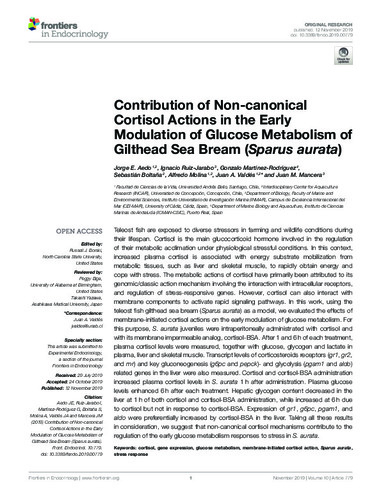
Teleost fish are exposed to diverse stressors in farming and wildlife conditions during
their lifespan. Cortisol is the main glucocorticoid hormone involved in the regulation
of their metabolic acclimation under physiological stressful conditions. In this context,
increased plasma cortisol is associated with energy substrate mobilization from
metabolic tissues, such as liver and skeletal muscle, to rapidly obtain energy and
cope with stress. The metabolic actions of cortisol have primarily been attributed to its
genomic/classic action mechanism involving the interaction with intracellular receptors,
and regulation of stress-responsive genes. However, cortisol can also interact with
membrane components to activate rapid signaling pathways. In this work, using the
teleost fish gilthead sea bream (Sparus aurata) as a model, we evaluated the effects of
membrane-initiated cortisol actions on the early modulation of glucose metabolism. For
this purpose, S. aurata juveniles were intraperitoneally administrated with cortisol and
with its membrane impermeable analog, cortisol-BSA. After 1 and 6 h of each treatment,
plasma cortisol levels were measured, together with glucose, glycogen and lactate in
plasma, liver and skeletal muscle. Transcript levels of corticosteroids receptors (gr1, gr2,
and mr) and key gluconeogenesis (g6pc and pepck)- and glycolysis (pgam1 and aldo)
related genes in the liver were also measured. Cortisol and cortisol-BSA administration
increased plasma cortisol levels in S. aurata 1 h after administration. Plasma glucose
levels enhanced 6 h after each treatment. Hepatic glycogen content decreased in the
liver at 1 h of both cortisol and cortisol-BSA administration, while increased at 6 h due
to cortisol but not in response to cortisol-BSA. Expression of gr1, g6pc, pgam1, and
aldo were preferentially increased by cortisol-BSA in the liver. Taking all these results
in consideration, we suggest that non-canonical cortisol mechanisms contribute to the
regulation of the early glucose metabolism responses to stress in S. aurata.
Colecciones
- Artículos Científicos [11777]
- Articulos Científicos Biología [857]
- Artículos Científicos INMAR [1027]

Esta obra está bajo una Licencia Creative Commons Atribución 4.0 Internacional