Revisión sobre técnicas de reconstrucción del hélix por cáncer de piel
Files
Statistics
Export





Metadata
Show full item recordAlternative title
Review of helical rim reconstruction techniques

Date
2019Source
Revista ORL, 2019 Vol. 10, núm. 4Abstract
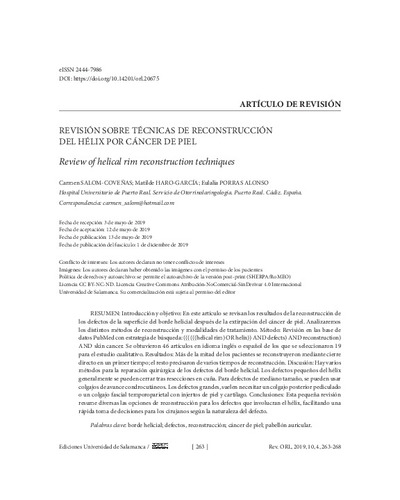
Introducción y objetivo: En este artículo se revisan los resultados de la reconstrucción de
los defectos de la superficie del borde helicial después de la extirpación del cáncer de piel. Analizaremos
los distintos métodos de reconstrucción y modalidades de tratamiento. Método: Revisión en las base de
datos PubMed con estrategia de búsqueda: ((((((helical rim) OR helix)) AND defects) AND reconstruction)
AND skin cancer. Se obtuvieron 46 artículos en idioma inglés o español de los que se seleccionaron 19
para el estudio cualitativo. Resultados: Más de la mitad de los pacientes se reconstruyeron mediante cierre
directo en un primer tiempo; el resto precisaron de varios tiempos de reconstrucción. Discusión: Hay varios
métodos para la reparación quirúrgica de los defectos del borde helicial. Los defectos pequeños del hélix
generalmente se pueden cerrar tras resecciones en cuña. Para defectos de mediano tamaño, se pueden usar
colgajos de avance condrocutáneos. Los defectos grandes, suelen necesitar un colgajo posterior pediculado
o un colgajo fascial temporoparietal con injertos de piel y cartílago. Conclusiones: Esta pequeña revisión
resume diversas las opciones de reconstrucción para los defectos que involucran el hélix, facilitando una
rápida toma de decisiones para los cirujanos según la naturaleza del defecto. Introduction and objective: In this article we review the results of the reconstruction of the
helical rim defects after the removal of the skin cancer. We Analyze the different methods of reconstruction
and treatment modalities. Method: Narrative review in PubMed databases and search strategy: (((((((helical
rim) OR helix)) AND defects) AND reconstruction) AND skin cancer. 46 articles were obtained in English
or Spanish from which were selected 19 for the qualitative study. Results: More than half were reconstructed
by simple single‐step techniques; others required several reconstruction times. Discussion: There are several
methods of surgical repair of helical rim defects. Small defects can usually be closed primarily with various
wedge resections. For medium-sized defects, chondrocutaneous advancement flaps. Large defects typically
need bipediculated tubing flaps or a temporoparietal fascial flap with skin and cartilage grafts. Conclusions:
This mini review summarizes various reconstruction options for defects involving helical rim defects,
facilitating rapid decision for surgeons according to the nature of the defect.
Collections
- Artículos Científicos [11777]
- Articulos Científicos Cirugía [103]

This work is under a Creative Commons License Attribution-NonCommercial-NoDerivatives 4.0 Internacional