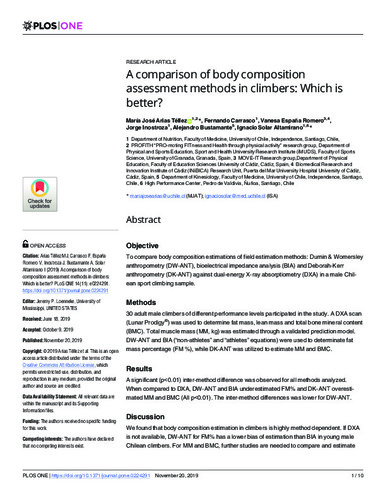
A comparison of body composition assessment methods in climbers: Which is better?
Identificadores
URI: http://hdl.handle.net/10498/23176
DOI: 10.1371/journal.pone.0224291
ISSN: 1932-6203
Ficheros
Estadísticas
Métricas y Citas
Exportar a





Metadatos
Mostrar el registro completo del ítem
Fecha
2019-11Fuente
PLoS ONE 14(11): e0224291Resumen
Objective
To compare body composition estimations of field estimation methods: Durnin & Womersley anthropometry (DW-ANT), bioelectrical impedance analysis (BIA) and Deborah-Kerr anthropometry (DK-ANT) against dual-energy X-ray absorptiometry (DXA) in a male Chilean sport climbing sample.
Methods
30 adult male climbers of different performance levels participated in the study. A DXA scan (Lunar Prodigy (R)) was used to determine fat mass, lean mass and total bone mineral content (BMC). Total muscle mass (MM, kg) was estimated through a validated prediction model. DW-ANT and BIA ("non-athletes" and "athletes" equations) were used to determinate fat mass percentage (FM %), while DK-ANT was utilized to estimate MM and BMC.
Results
A significant (p<0.01) inter-method difference was observed for all methods analyzed. When compared to DXA, DW-ANT and BIA underestimated FM% and DK-ANT overestimated MM and BMC (All p< 0.01). The inter-method differences was lower for DW-ANT.
Discussion
We found that body composition estimation in climbers is highly method dependent. If DXA is not available, DW-ANT for FM% has a lower bias of estimation than BIA in young male Chilean climbers. For MM and BMC, further studies are needed to compare and estimate the DK-ANT bias level. For both methods, correction equations for specific climbing population should be considered.
Colecciones
- Artículos Científicos [11595]
- Articulos Científicos Did. E. Fis. [443]
- Artículos Científicos INIBICA [1046]

Esta obra está bajo una Licencia Creative Commons Attribution-NonCommercial-NoDerivatives 4.0 Internacional