Toward Automated Feature Extraction for Deep Learning Classification of Electrocardiogram Signals
Identificadores
URI: http://hdl.handle.net/10498/28744
DOI: 10.1109/ACCESS.2022.3220670
ISSN: 2169-3536
Ficheros
Estadísticas
Métricas y Citas
Exportar a





Metadatos
Mostrar el registro completo del ítem
Fecha
2022Fuente
IEEE Access, Vol. 10, 2022, pp. 118601-118616Resumen
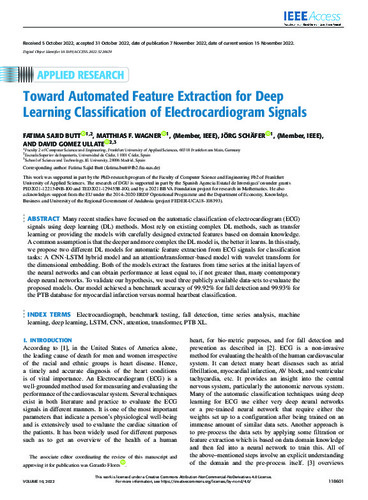
Many recent studies have focused on the automatic classification of electrocardiogram (ECG) signals using deep learning (DL) methods. Most rely on existing complex DL methods, such as transfer learning or providing the models with carefully designed extracted features based on domain knowledge. A common assumption is that the deeper and more complex the DL model is, the better it learns. In this study, we propose two different DL models for automatic feature extraction from ECG signals for classification tasks: A CNN-LSTM hybrid model and an attention/transformer-based model with wavelet transform for the dimensional embedding. Both of the models extract the features from time series at the initial layers of the neural networks and can obtain performance at least equal to, if not greater than, many contemporary deep neural networks. To validate our hypothesis, we used three publicly available data-sets to evaluate the proposed models. Our model achieved a benchmark accuracy of 99.92% for fall detection and 99.93% for the PTB database for myocardial infarction versus normal heartbeat classification.
Colecciones
- Artículos Científicos [11595]
- Articulos Científicos Ing. Inf. [299]

Esta obra está bajo una Licencia Creative Commons Attribution-NonCommercial-NoDerivatives 4.0 Internacional