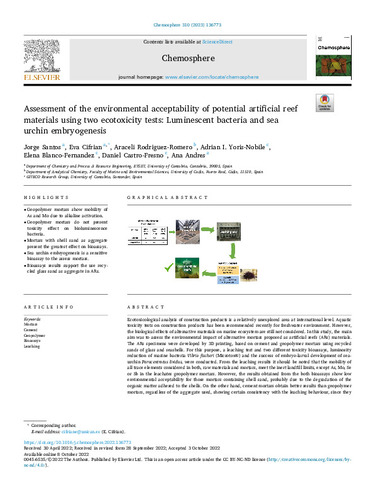
Assessment of the environmental acceptability of potential artificial reef materials using two ecotoxicity tests: Luminescent bacteria and sea urchin embryogenesis
Identificadores
URI: http://hdl.handle.net/10498/29423
DOI: 10.1016/j.chemosphere.2022.136773
ISSN: 0045-6535
Files
Statistics
Metrics and citations
Export





Metadata
Show full item record
Date
2022-10-08Source
Chemosphere. Vol. 310, January 2023, 136773Abstract
Ecotoxicological analysis of construction products is a relatively unexplored area at international level. Aquatic toxicity tests on construction products has been recommended recently for freshwater environment. However, the biological effects of alternative materials on marine ecosystem are still not considered. In this study, the main aim was to assess the environmental impact of alternative mortars proposed as artificial reefs (ARs) materials. The ARs specimens were developed by 3D printing, based on cement and geopolymer mortars using recycled sands of glass and seashells. For this purpose, a leaching test and two different toxicity bioassays, luminosity reduction of marine bacteria Vibrio fischeri (Microtox®) and the success of embryo-larval development of sea-urchin Paracentrotus lividus, were conducted. From the leaching results it should be noted that the mobility of all trace elements considered in both, raw materials and mortars, meet the inert landfill limits, except As, Mo, Se or Sb in the leachates geopolymer mortars. However, the results obtained from the both bioassays show low environmental acceptability for those mortars containing shell sand, probably due to the degradation of the organic matter adhered to the shells. On the other hand, cement mortars obtain better results than geopolymer mortars, regardless of the aggregate used, showing certain consistency with the leaching behaviour, since they present the lowest mobility of trace chemical elements. Therefore, the results supporting the environmental acceptability of its potential use as alternative materials in the production of ARs.
Collections
- Artículos Científicos [11777]
- Articulos Científicos Quim. Ana. [393]

This work is under a Creative Commons License Attribution-NonCommercial-NoDerivatives 4.0 Internacional