Multi-functional oxidase-like activity of praseodymia nanorods and nanoparticles
Identificadores
URI: http://hdl.handle.net/10498/30004
DOI: 10.1016/J.APSUSC.2022.155502
ISSN: 0169-4332
Estadísticas
Métricas y Citas
Exportar a





Metadatos
Mostrar el registro completo del ítem
Fecha
2023Fuente
Applied Surface Science-2023, Vol. 610, pp155502Resumen
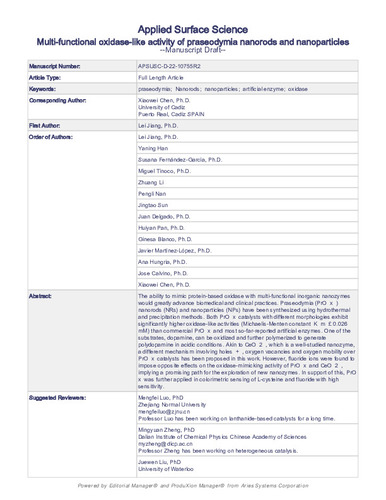
The ability to mimic protein-based oxidase with multi-functional inorganic nanozymes would greatly advance
biomedical and clinical practices. Praseodymia (PrOx) nanorods (NRs) and nanoparticles (NPs) have been synthesized
using hydrothermal and precipitation methods. Both PrOx catalysts with different morphologies exhibit
significantly higher oxidase-like activities (Michaelis-Menten constant Km ≤ 0.026 mM) than commercial PrOx
and most so-far-reported artificial enzymes. One of the substrates, dopamine, can be oxidized and further
polymerized to generate polydopamine in acidic conditions. Akin to CeO2, which is a well-studied nanozyme, a
different mechanism involving holes+, oxygen vacancies and oxygen mobility over PrOx catalysts has been
proposed in this work. However, fluoride ions were found to impose opposite effects on the oxidase-mimicking
activity of PrOx and CeO2, implying a promising path for the exploration of new nanozymes. In support of this,
PrOx was further applied in colorimetric sensing of L-cysteine and fluoride with high sensitivity.
Colecciones
- Artículos Científicos [11777]
- Articulos Científicos CC. Mat. [566]
- Artículos Científicos IMEYMAT [565]

Esta obra está bajo una Licencia Creative Commons Attribution-NonCommercial-NoDerivatives 4.0 Internacional