Potencialidades y desafíos para la gestión integrada costera en el Departamento de San José
Identificadores
URI: http://hdl.handle.net/10498/32652
DOI: 10.25267/Costas.2023.v5.i1.0303
ISSN: 2304-0963
Files
Statistics
Metrics and citations
Export





Metadata
Show full item recordAlternative title
Potentialities and Challenges for Integrated Coastal Management in the Department of San José
Date
2023Source
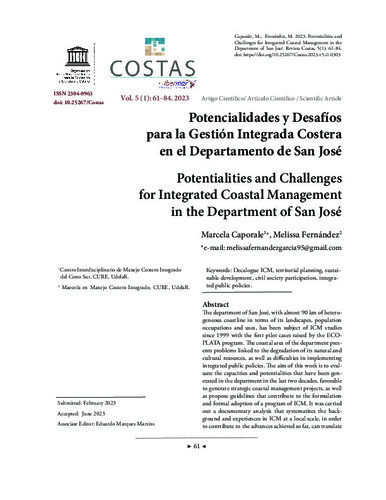
Costas, 5(1), 61–84Abstract
El Departamento de San José (Uruguay), con casi 90 km de línea de costa heterogénea en cuanto a sus paisajes, ocupaciones poblacionales y usos, ha sido objeto de estudio en clave MCI desde el año 1999 con los primeros casos pilotos
planteados por el programa ECOPLATA. La zona costera del departamento presenta problemáticas vinculadas a la
degradación de sus recursos naturales y culturales, así como se han planteado dificultades para implementar políticas
públicas integradas. El objetivo de este trabajo es el de evaluar las capacidades y potencialidades que se han generado en
el Departamento en las últimas dos décadas, favorables para generar proyectos estratégicos de gestión costera, así como
plantear lineamientos que contribuyan a la formulación y adopción formal de un programa de MCI. Se realizó un análisis documental que sistematiza los antecedentes y experiencias en MCI a escala local, para poder contribuir a que, los
avances logrados hasta el momento, puedan traducirse en aprendizajes y contengan la valía de ser procesos acumulativos.
Los antecedentes analizados permitieron, a pesar de sus diferentes niveles de alcance, plantear líneas de reflexión sobre
las particularidades y desafíos locales para avanzar en un modelo MCI a escala departamental. Algunos de los resultados
preliminares del trabajo, refieren a la identificación de asuntos clave que presentan cierto grado de avance en su gestión, como son la formulación e implementación de planes locales de ordenamiento territorial y desarrollo sustentable,
gestión de áreas protegidas, adaptación al cambio climático, gestión del patrimonio cultural, entre otros. Asimismo,
surgen como fortalezas para un proceso de MCI, la predisposición de actores institucionales, la existencia de espacios de
coordinación intersectorial en el ámbito de la Intendencia Departamental, marco normativo referido a ordenamiento
territorial, entre otros. Por otro lado, algunos de los aspectos más débiles a prestar atención se relacionan con la limitada
permanencia y capacidad de las iniciativas de participación civil, así como la falta de estrategias de comunicación. The department of San José, with almost 90 km of heterogeneous coastline in terms of its landscapes, population
occupations and uses, has been subject of ICM studies
since 1999 with the first pilot cases raised by the ECOPLATA program. The coastal area of the department presents problems linked to the degradation of its natural and
cultural resources, as well as difficulties in implementing
integrated public policies. The aim of this work is to evaluate the capacities and potentialities that have been generated in the department in the last two decades, favorable
to generate strategic coastal management projects, as well
as propose guidelines that contribute to the formulation
and formal adoption of a program of ICM. It was carried
out a documentary analysis that systematizes the background and experiences in ICM at a local scale, in order
to contribute to the advances achieved so far, can translate into learning and contain the value of being cumulative processes. The antecedents analyzed allowed, despite their different levels of scope, to raise lines of reflection on local particularities and challenges to advance a ICM model at the
departmental scale. Some of the preliminary results of work refer to the identification of key issues that present a certain
degree of progress in their management, such as the formulation and implementation of local territorial planning plans
and sustainable development, management of protected areas, adaptation to climate change, Cultural Heritage Management, among others. Furthermore, also arise as strengths for an ICM process, the predisposition of institutional actors,
the existence of intersectoral coordination spaces in the field of the departmental government, regulatory framework
referring to territorial planning, among others. On the other hand, some of the weakest aspects to pay attention are
related to the limited permanence and capacity of civil participation initiatives, as well as the lack of communication
strategies for development.
Collections

This work is under a Creative Commons License Attribution-NonCommercial-NoDerivatives 4.0 Internacional