Oral cortisol and dexamethasone intake: Differential physiology and transcriptional responses in the marine juvenile Sparus aurata
Identificadores
URI: http://hdl.handle.net/10498/32669
DOI: https://doi.org/10.1016/J.YGCEN.2023.114371
ISSN: 1095-6840
ISSN: 0016-6480
Ficheros
Estadísticas
Métricas y Citas
Exportar a





Metadatos
Mostrar el registro completo del ítem
Fecha
2023Fuente
General and Comparative Endocrinology - 2023, Vol. 344Resumen
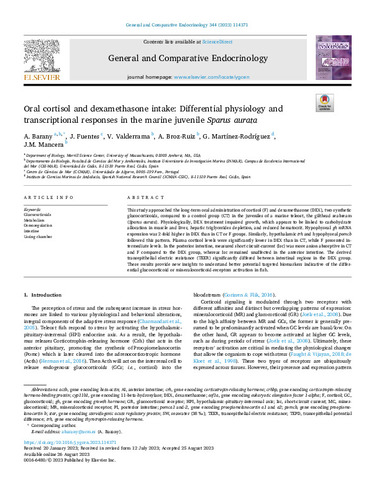
This study approached the long-term oral administration of cortisol (F) and dexamethasone (DEX), two synthetic glucocorticoids, compared to a control group (CT) in the juveniles of a marine teleost, the gilthead seabream (Sparus aurata). Physiologically, DEX treatment impaired growth, which appears to be linked to carbohydrate allocation in muscle and liver, hepatic triglycerides depletion, and reduced hematocrit. Hypophyseal gh mRNA expression was 2-fold higher in DEX than in CT or F groups. Similarly, hypothalamic trh and hypophyseal pomcb followed this pattern. Plasma cortisol levels were significantly lower in DEX than in CT, while F presented intermediate levels. In the posterior intestine, measured short circuit-current (Isc) was more anion absorptive in CT and F compared to the DEX group, whereas Isc remained unaffected in the anterior intestine. The derived transepithelial electric resistance (TEER) significantly differed between intestinal regions in the DEX group. These results provide new insights to understand better potential targeted biomarkers indicative of the differential glucocorticoid or mineralocorticoid-receptors activation in fish.
Colecciones
- Artículos Científicos [11777]
- Articulos Científicos Biología [857]
- Artículos Científicos INMAR [1027]
- Investigación Ceimar [188]

Esta obra está bajo una Licencia Creative Commons Atribución 4.0 Internacional