Criterion-related validity and reliability of the standing long jump test in adults: The Adult-Fit project
Identificadores
URI: http://hdl.handle.net/10498/35573
DOI: 10.1002/ejsc.12182
ISSN: 1536-7290
ISSN: 1746-1391
Ficheros
Estadísticas
Métricas y Citas
Exportar a





Metadatos
Mostrar el registro completo del ítem
Fecha
2024-08-31Fuente
European Journal of Sport Science, Vol. 24, Núm. 9, 2024, pp. 1379-1392Resumen
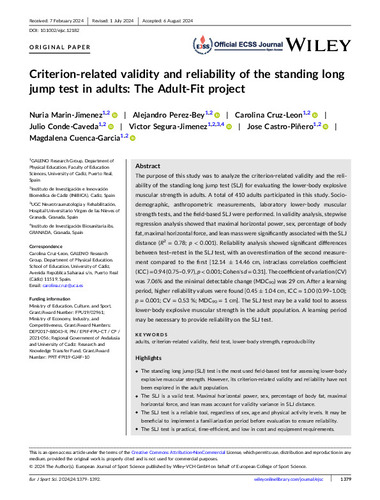
The purpose of this study was to analyze the criterion‐related validity and the reli-ability of the standing long jump test (SLJ) for evaluating the lower‐body explosivemuscular strength in adults. A total of 410 adults participated in this study. Socio-demographic, anthropometric measurements, laboratory lower‐body muscularstrength tests, and the field‐based SLJ were performed. In validity analysis, stepwiseregression analysis showed that maximal horizontal power, sex, percentage of bodyfat, maximal horizontal force, and lean mass were significantly associated with the SLJdistance (R2 = 0.78; p < 0.001). Reliability analysis showed significant differencesbetween test–retest in the SLJ test, with an overestimation of the second measure-ment compared to the first [12.14 � 14.46 cm, intraclass correlation coefficient(ICC) = 0.94 (0.75–0.97), p < 0.001; Cohen's d = 0.31]. The coefficient of variation (CV)was 7.06% and the minimal detectable change (MDC90) was 29 cm. After a learningperiod, higher reliability values were found [0.45 � 1.04 cm, ICC = 1.00 (0.99–1.00);p = 0.001; CV = 0.53 %; MDC90 = 1 cm]. The SLJ test may be a valid tool to assesslower‐body explosive muscular strength in the adult population. A learning periodmay be necessary to provide reliability on the SLJ test
Colecciones
- Artículos Científicos [11595]
- Articulos Científicos Did. E. Fis. [443]
- Artículos Científicos INIBICA [1046]

Esta obra está bajo una Licencia Creative Commons Atribución-NoComercial 4.0 Internacional