Effects of Different Ranges of Loads on Physical Performance Using Velocity-Based Resistance Training
Ficheros
Estadísticas
Métricas y Citas
Exportar a





Metadatos
Mostrar el registro completo del ítem
Fecha
2025-04Fuente
Sports - 2025, Vol 13 n. 4, artículo 121Resumen
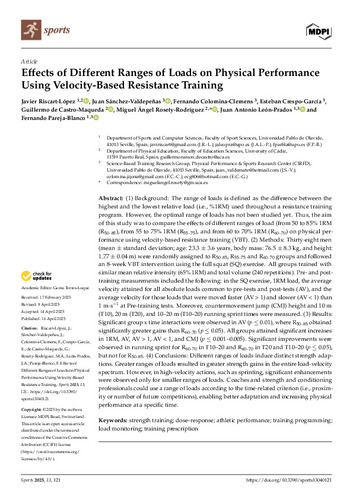
The range of loads is defined as the difference between the highest and the lowest relative load (i.e., %1RM) used throughout a resistance training program. However, the optimal range of loads has not been studied yet. Thus, the aim of this study was to compare the effects of different ranges of load (from 50 to 85% 1RM (R50–85), from 55 to 75% 1RM (R55–75), and from 60 to 70% 1RM (R60–70) on physical performance using velocity-based resistance training (VBT). (2) Methods: Thirty-eight men (mean ± standard deviation; age: 23.3 ± 3.6 years, body mass: 76.5 ± 8.3 kg, and height: 1.77 ± 0.04 m) were randomly assigned to R50–85, R55–75 and R60–70 groups and followed an 8-week VBT intervention using the full squat (SQ) exercise. All groups trained with similar mean relative intensity (65% 1RM) and total volume (240 repetitions). Pre- and post-training measurements included the following: in the SQ exercise, 1RM load, the average velocity attained for all absolute loads common to pre-tests and post-tests (AV), and the average velocity for those loads that were moved faster (AV > 1) and slower (AV < 1) than 1 m·s−1 at Pre-training tests. Moreover, countermovement jump (CMJ) height and 10 m (T10), 20 m (T20), and 10–20 m (T10–20) running sprint times were measured. (3) Results: Significant group x time interactions were observed in AV (p ≤ 0.01), where R50–85 obtained significantly greater gains than R60–70 (p ≤ 0.05). All groups attained significant increases in 1RM, AV, AV > 1, AV < 1, and CMJ (p ≤ 0.001–0.005). Significant improvements were observed in running sprint for R60–70 in T10–20 and R60–70 in T20 and T10–20 (p ≤ 0.05), but not for R50–85. (4) Conclusions: Different ranges of loads induce distinct strength adaptions. Greater ranges of loads resulted in greater strength gains in the entire load-velocity spectrum. However, in high-velocity actions, such as sprinting, significant enhancements were observed only for smaller ranges of loads. Coaches and strength and conditioning professionals could use a range of loads according to the time-related criterion (i.e., proximity or number of future competitions), enabling better adaptation and increasing physical performance at a specific time.
Colecciones
- Artículos Científicos [11777]
- Articulos Científicos Cirugía [103]
- Articulos Científicos Medicina [297]

Esta obra está bajo una Licencia Creative Commons Atribución 4.0 Internacional