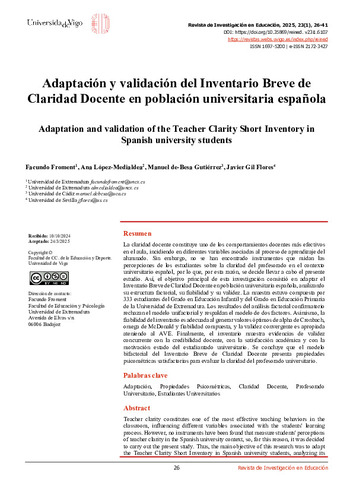
Adaptación y validación del Inventario Breve de Claridad Docente en población universitaria española
Identificadores
URI: http://hdl.handle.net/10498/38636
DOI: 10.35869/REINED.V23I1.6107
ISSN: 1697-5200
ISSN: 2172-3427
Statistics
Metrics and citations
Export





Metadata
Show full item recordAlternative title
Adaptation and validation of the Teacher Clarity Short Inventory in Spanish university students

Date
2025Source
Revista de Investigación en Educación - 2025, Vol. 23 n. 1 pp. 26 - 41Abstract
La claridad docente constituye uno de los comportamientos docentes más efectivos
en el aula, incidiendo en diferentes variables asociadas al proceso de aprendizaje del
alumnado. Sin embargo, no se han encontrado instrumentos que midan las
percepciones de los estudiantes sobre la claridad del profesorado en el contexto
universitario español, por lo que, por esta razón, se decide llevar a cabo el presente
estudio. Así, el objetivo principal de esta investigación consistió en adaptar el
Inventario Breve de Claridad Docente en población universitaria española, analizando
su estructura factorial, su fiabilidad y su validez. La muestra estuvo compuesta por
333 estudiantes del Grado en Educación Infantil y del Grado en Educación Primaria
de la Universidad de Extremadura. Los resultados del análisis factorial confirmatorio
rechazan el modelo unifactorial y respaldan el modelo de dos factores. Asimismo, la
fiabilidad del inventario es adecuada al generar valores óptimos de alpha de Cronbach,
omega de McDonald y fiabilidad compuesta, y la validez convergente es apropiada
ateniendo al AVE. Finalmente, el inventario muestra evidencias de validez
concurrente con la credibilidad docente, con la satisfacción académica y con la
motivación estado del estudiantado universitario. Se concluye que el modelo
bifactorial del Inventario Breve de Claridad Docente presenta propiedades
psicométricas satisfactorias para evaluar la claridad del profesorado universitario. Teacher clarity constitutes one of the most effective teaching behaviors in the classroom, influencing different variables associated with the students' learning process. However, no instruments have been found that measure students' perceptions of teacher clarity in the Spanish university context, so, for this reason, it was decided to carry out the present study. Thus, the main objective of this research was to adapt the Teacher Clarity Short Inventory in Spanish university students, analyzing its factor structure, its reliability and its validity. The sample was made up of 333 students from the Degree in Early Childhood Education and the Degree in Primary Education from the University of Extremadura. The results of the confirmatory factor analysis reject the single-factor model and support the two-factor model. Likewise, the reliability of the inventory is adequate by generating optimal values of Cronbach's alpha, McDonald's omega and composite reliability and the convergent validity is satisfactory according to AVE. Finally, the inventory shows evidence of concurrent validity with instructor credibility, academic satisfaction and state motivation of university students. It is concluded that the bifactor model of the Teacher Clarity Short Inventory presents satisfactory psychometric properties to evaluate the clarity of university teachers.
Collections
- Artículos Científicos [11777]
- Articulos Científicos Didáctica [465]

This work is under a Creative Commons License Attribution-NonCommercial-NoDerivatives 4.0 Internacional