Climate change is associated with a higher extinction risk of a subshrub in anthropogenic landscapes
Statistics
Metrics and citations
Export





Metadata
Show full item record
Date
2025Source
Journal of Ecology - 2025, Vol. 113 n. 11 pp. 3124-3140Abstract
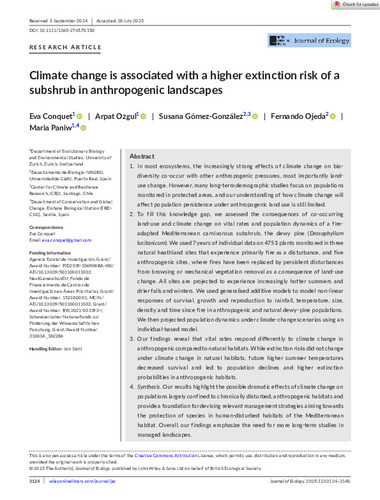
1. In most ecosystems, the increasingly strong effects of climate change on biodiversity
co-occur
with other anthropogenic pressures, most importantly land-use
change. However, many long-term
demographic studies focus on populations
monitored in protected areas, and our understanding of how climate change will
affect population persistence under anthropogenic land use is still limited.
2. To fill this knowledge gap, we assessed the consequences of co-occurring
land-use
and climate change on vital rates and population dynamics of a fire-adapted
Mediterranean carnivorous subshrub, the dewy pine (Drosophyllum
lusitanicum). We used 7 years of individual data on 4753 plants monitored in three
natural heathland sites that experience primarily fire as a disturbance, and five
anthropogenic sites, where fires have been replaced by persistent disturbances
from browsing or mechanical vegetation removal as a consequence of land-use
change. All sites are projected to experience increasingly hotter summers and
drier falls and winters. We used generalised additive models to model non-linear
responses of survival, growth and reproduction to rainfall, temperature, size,
density and time since fire in anthropogenic and natural dewy-pine
populations.
We then projected population dynamics under climate-change
scenarios using an
individual-based
model.
3. Our findings reveal that vital rates respond differently to climate change in
anthropogenic compared to natural habitats. While extinction risks did not change
under climate change in natural habitats, future higher summer temperatures
decreased survival and led to population declines and higher extinction
probabilities in anthropogenic habitats.
4. Synthesis. Our results highlight the possible dramatic effects of climate change on
populations largely confined to chronically disturbed, anthropogenic habitats and
provide a foundation for devising relevant management strategies aiming towards
the protection of species in human-disturbed
habitats of the Mediterranean
habitat. Overall, our findings emphasize the need for more long-term
studies in
managed landscapes.
Collections
- Artículos Científicos [12089]
- Articulos Científicos Biología [888]
- Artículos Científicos IVAGRO [737]

This work is under a Creative Commons License Attribution-NonCommercial-NoDerivatives 4.0 Internacional