• español
    • English
  • Login
  • English 
    • español
    • English

UniversidaddeCádiz

Área de Biblioteca, Archivo y Publicaciones
Communities and Collections
View Item 
  •   RODIN Home
  • Producción Científica
  • Artículos Científicos
  • View Item
  •   RODIN Home
  • Producción Científica
  • Artículos Científicos
  • View Item
JavaScript is disabled for your browser. Some features of this site may not work without it.

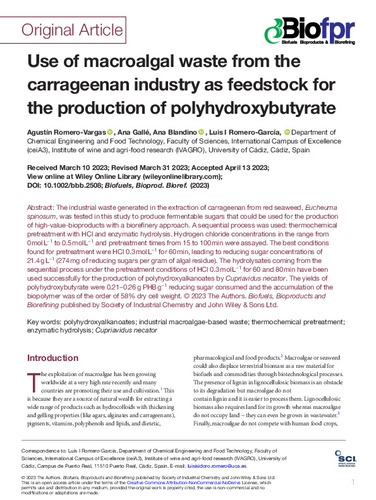
Use of macroalgal waste from the carrageenan industry as feedstock for the production of polyhydroxybutyrate
Thumbnail
Identificadores

URI: http://hdl.handle.net/10498/28647

DOI: 10.1002/bbb.2508

ISSN: 1932-104X

Files
APC_2023_034.pdf (2.609Mb)
Statistics
View statistics
Metrics and citations
 
Share
Export
Export reference to MendeleyRefworksEndNoteBibTexRIS
Metadata
Show full item record
Author/s
Romero Vargas, AgustínAuthority UCA; Gallé, Ana; Blandino Garrido, Ana MaríaAuthority UCA; Romero García, Luis IsidoroAuthority UCA
Date
2023-04
Department
Ingeniería Química y Tecnología de Alimentos
Source
Biofuels, Bioproducts and Biorefining (2023)
Abstract
The industrial waste generated in the extraction of carrageenan from red seaweed, Eucheuma spinosum, was tested in this study to produce fermentable sugars that could be used for the production of high-value-bioproducts with a biorefinery approach. A sequential process was used: thermochemical pretreatment with HCl and enzymatic hydrolysis. Hydrogen chloride concentrations in the range from 0 mol L−1 to 0.5 mol L−1 and pretreatment times from 15 to 100 min were assayed. The best conditions found for pretreatment were HCl 0.3 mol L−1 for 60 min, leading to reducing sugar concentrations of 21.4 g L−1 (274 mg of reducing sugars per gram of algal residue). The hydrolysates coming from the sequential process under the pretreatment conditions of HCl 0.3 mol L−1 for 60 and 80 min have been used successfully for the production of polyhydroxyalkanoates by Cupriavidus necator. The yields of polyhydroxybutyrate were 0.21–0.26 g PHB g−1 reducing sugar consumed and the accumulation of the biopolymer was of the order of 58% dry cell weight. © 2023 The Authors. Biofuels, Bioproducts and Biorefining published by Society of Industrial Chemistry and John Wiley & Sons Ltd.
Subjects
Cupriavidus necator; enzymatic hydrolysis; industrial macroalgae-based waste; polyhydroxyalkanoates; thermochemical pretreatment
Collections
  • Artículos Científicos [11620]
  • Articulos Científicos Ing. Quim. [302]
  • Artículos Científicos IVAGRO [718]
Attribution-NonCommercial-NoDerivatives 4.0 Internacional
This work is under a Creative Commons License Attribution-NonCommercial-NoDerivatives 4.0 Internacional

Browse

All of RODINCommunities and CollectionsBy Issue DateAuthorsTitlesSubjectsThis CollectionBy Issue DateAuthorsTitlesSubjects

My Account

LoginRegister

Statistics

View Usage Statistics

Información adicional

AboutDeposit in RODINPoliciesGuidelinesRightsLinksStatisticsNewsFrequently Asked Questions

RODIN is available through

OpenAIREOAIsterRecolectaHispanaEuropeanaBaseDARTOATDGoogle Academic

Related links

Sherpa/RomeoDulcineaROAROpenDOARCreative CommonsORCID

RODIN está gestionado por el Área de Biblioteca, Archivo y Publicaciones de la Universidad de Cádiz

Contact informationSuggestionsUser Support